Best Acupressure Mat for Sleep: ProsourceFit Wins

Six acupressure mats compared for a pre-bed routine, ranked by spike count, mat length, filling and set contents, with a clear winner and three flips.

By Tanner TorresUpdated 17 min read
On this page
- Best acupressure mat for sleep at a glance
- How I narrowed six mats down from a crowded shelf
- Does an acupressure mat actually help you fall asleep?
- 1. ProsourceFit Acupressure Mat and Pillow Set — Best overall
- 2. XiaoMaGe 28.7 in Acupressure Mat and Pillow Set — Best upgrade
- 3. Gaiam Acupressure Mat and Pillow Set — Best budget pick
- 4. DoSensePro Acupressure Mat and Pillow Set — Best for families
- 5. UNMERA Acupressure Mat and Pillow Set — Most versatile
- 6. ShaktiMat Premium Level 2 — Best premium
- What decides an acupressure mat for a bedtime routine
- Foam, coconut fibre or Blissfoam: which filling suits sleep?
- How long should you lie on the mat before bed?
- What the listings do not tell you
- The verdict
- FAQ
The best acupressure mat for sleep is the ProsourceFit Acupressure Mat and Pillow Set, a 25 x 15.8 in mat with 8,910 spikes and a matching neck pillow at 1.8 lb. If you are taller and want a longer surface, the XiaoMaGe 28.7 in set is the better wind-down choice.
Most guides for this category chase spike counts. That is not what decides a bedtime pick. Whether the mat covers your back and neck at the same time, and whether the filling feels supportive after ten minutes lying still, matters more than an extra thousand plastic points.
Amazon's search for the sleep angle is thin here. None of these listings publishes clinical sleep data, so treat the sleep claim as a routine you build around the mat, not a feature the mat performs on its own.
Best acupressure mat for sleep at a glance
| Pick | Mat length | Filling | Price |
|---|---|---|---|
Best overall ProsourceFit Acupressure Mat and Pillow Set |
25 in | Plant-based eco foam | Check Price |
Best upgrade XiaoMaGe 28.7 in Acupressure Mat and Pillow Set |
28.7 in | High-elastic foam (claim) | Check Price |
Best budget pick Gaiam Acupressure Mat and Pillow Set |
Not listed | Not listed | Check Price |
Best for families DoSensePro Acupressure Mat and Pillow Set |
29 in (claim) | High-density foam (claim) | Check Price |
Most versatile UNMERA Acupressure Mat and Pillow Set |
27.9 in | Coconut fibre | Check Price |
Best premium ShaktiMat Premium Level 2 |
29 in | Organic Blissfoam (claim) | Check Price |




How I narrowed six mats down from a crowded shelf
The category is stuffed with near-identical mats, so I cut hard before comparing anything. I lined up the published specifications side by side and dropped anything without a stated size, weight or dimension where a comparable pick had one.
Three criteria did the heavy lifting.
- Set completeness. For a bedtime routine, a matching neck pillow is not optional. Five of the six ship with a pillow; one lists the pillow inside a broader set.
- Mat length. A full back plus a neck pillow needs roughly 24 inches of surface at a minimum. Two picks sit under 26 inches, three sit at 28 inches or above.
- Filling type. Foam, coconut fibre and the branded Blissfoam behave differently under a still body. This is where the best acupressure mat for sleep separates from a generic recovery mat.
I did not screen on price. Every price band shows up in the final six, because the deciding features do not track price cleanly in this category.
Two things I explicitly did not use: any customer feedback, and any implied medical benefit. The listings all promise better sleep in loose language. Treat that as marketing, not a spec.
Does an acupressure mat actually help you fall asleep?
Does an acupressure mat actually help you fall asleep? None of these six listings publishes clinical evidence for that, so the honest answer is that the mat is a routine cue rather than a sedative. Lying still for 15 to 20 minutes, breathing slowly, and letting the spikes hold your attention is a wind-down ritual. That is what most shoppers are buying, whether the listing says so or not.
The feature bullets across the six lean into this. ProSource says the mat releases endorphins that relax muscles when used for 10 to 30 minutes daily. Gaiam positions the routine as 10 to 15 minutes of light pressure against a chair before advancing to lying flat. DoSensePro claims users fall asleep on the mat with fewer nighttime wake-ups, though that is a marketing statement, not measured data.
The practical takeaway is straightforward. An acupressure mat for sleep works if you commit to the routine. It fails if you expect the mat to sedate you the way medication would. Buy for the routine, not for a promise.
1. ProsourceFit Acupressure Mat and Pillow Set — Best overall
The ProsourceFit set is the best acupressure mat for sleep because it packs the most published spikes into a full-back mat with a matching neck pillow at 1.8 lb.
Best for: a nightly 15-minute wind-down on a full-length mat Skip it if: you are over six feet tall and want lumbar coverage
The ProsourceFit set is the only pick here with a published spike count. ProSource states the mat and pillow together carry 8,910 acupressure points, which is a concrete figure the other five listings simply do not give you. That matters when you are trying to compare pressure density rather than trust a marketing photo.
The mat measures 1 x 25 x 15.8 in and weighs 1.8 lb, which puts it in the lightest tier of the six. It is short compared with the 29 in mats further down the list, so a tall user will lose either the neck or the lumbar contact patch. For an average-height side sleeper wanting the mat plus pillow to cover both back and neck, the length works.
ProSource frames the routine as 10 to 30 minutes of daily use, and describes the foam as plant-based eco foam wrapped in 100% thick cotton. Both are the manufacturer's claims. The trade-off against the field is length: cheaper picks give you more inches for a lower price rank, and the ShaktiMat gives you sharper spikes for the highest price position here.
Pros:
- Published 8,910 spike count, the only one in the set
- Full mat and pillow at a mid price position
- Light 1.8 lb kit, easy to keep beside the bed
- Standard 15.8 in width fits most torsos
Cons:
- 25 in mat is the shortest in this set
- No published warranty
- Foam described only as eco foam, no density given
2. XiaoMaGe 28.7 in Acupressure Mat and Pillow Set — Best upgrade
The XiaoMaGe set gives you 28.7 inches of mat length at the second-cheapest price position of the six, which is the strongest length-for-money combination here.

Best for: taller sleepers who want a longer mat without paying premium Skip it if: you prefer a natural filling over foam
XiaoMaGe publishes the dimensions most clearly of any pick: 0.78 x 28.7 x 16.5 in for the mat, with the pillow at 15.3 x 5.9 x 3 in as listed. That extra 3.7 inches over the ProsourceFit is enough to cover the lumbar region while the pillow supports the neck, which is exactly the geometry a bedtime routine needs.
The kit is a three-piece set including a carry bag. Weight comes in at 1.87 lb, essentially the same as the winner. XiaoMaGe describes the spikes as 100% non-toxic plastic needles on high-elastic foam, and frames the routine as lying and sitting on the mat and pillow to promote circulation. Those are claims from the listing, not measured performance.
Against the ProsourceFit, XiaoMaGe wins on length and loses on transparency: no published spike count, no warranty. Against the ShaktiMat, it matches the length and undercuts the price band, but the ShaktiMat publishes materials in more detail.
Pros:
- 28.7 in mat length, second-longest in the set
- Second-cheapest price position of the six
- Carry bag included in the three-piece set
- Clear dimensional data on both mat and pillow
Cons:
- No published spike count
- Filling described only as high-elastic foam
- No stated warranty
3. Gaiam Acupressure Mat and Pillow Set — Best budget pick
Gaiam is the cheapest set here and the only one with a published warranty, which makes it the least risky first mat to try.
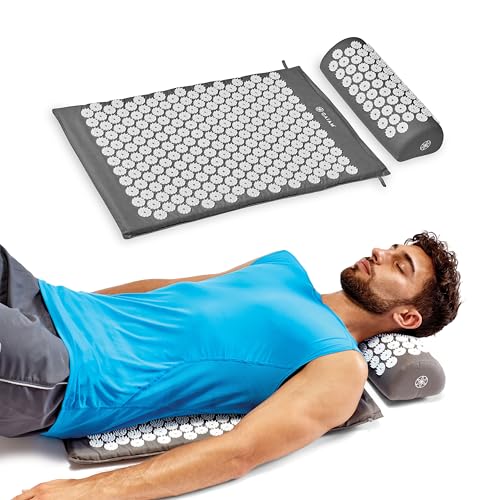
Best for: a first-time buyer testing the routine before committing Skip it if: you want a published spike count on the listing
Gaiam holds the cheapest price position of the six and is the only pick with a stated warranty, listed simply as Limited. It is also the oldest of the set, released in 2019, which means the design has been on the market long enough that Gaiam has kept the specification stable rather than iterating every year.
The published dimensions are 7.5 x 16 x 7.75 in, which reads as the rolled or packaged form rather than the mat unrolled, so you should treat the length as unknown. Weight is 1.92 lb. Gaiam positions the routine as 10 to 15 minutes of light pressure against a chair or couch to start, then direct pressure lying flat as you progress. That is a sensible entry ramp for someone new to the sensation.
The listing is thinner on quantitative detail than any other pick. There is no spike count, no filling type and no unrolled mat length. If you are shopping to test whether the routine helps you sleep before spending more, the low price and the warranty offset the thin data.
Pros:
- Cheapest of the six by price rank
- Only pick with a published warranty
- Gentle onboarding routine described in the listing
- Established design, on the market since 2019
Cons:
- No unrolled mat length in the specifications
- No published spike count or filling type
- Slowest seller of the four picks in the acupuncture category
4. DoSensePro Acupressure Mat and Pillow Set — Best for families
DoSensePro is the only pick that ships with a hot/cold gel pack alongside the mat and pillow, which makes it the most flexible kit for a household using it in different ways.

Best for: a shared mat used by more than one person, with a hot/cold pack Skip it if: you want a published weight or spike count
The DoSensePro listing is a three-piece set with a mat, pillow, carry bag and reusable hot/cold gel pack. That last piece is the differentiator: none of the other five kits includes one. If one person in the household wants heat on a stiff neck while another wants cold on a strained back, the same kit covers both without a second purchase.
DoSensePro claims a 29 in mat and 7,992 pressure points across mat and pillow. Both are manufacturer figures, not independently verified. The published dimensions on the listing are 6.5 x 17.2 x 8.5 in, which look like packaged rather than unrolled measurements. No weight is listed for the set, which is unusual for this category.
The trade-off is the same one you get with any kit that bundles extras: you are paying a mid price for the bundle, so if you already own a hot/cold pack, the bundle is less compelling. Compared with the ProsourceFit, DoSensePro claims more length and includes more items but publishes fewer hard specifications.
Pros:
- Only pick with a hot/cold gel pack included
- Carry bag included with the set
- Claimed 29 in mat, tied for longest in the field
- 7,992 pressure points claimed across mat and pillow
Cons:
- No weight published on the listing
- Dimensions appear to be packaged, not unrolled
- Spike count and length are claims, not verified
5. UNMERA Acupressure Mat and Pillow Set — Most versatile
UNMERA is the only pick filled with coconut fibre rather than foam, and it is the only set to include a separate lumbar cushion alongside the neck pillow.

Best for: a natural-fibre setup with a separate lumbar cushion Skip it if: a 4.96 lb kit is too heavy to keep on the bed
UNMERA takes a different route from the rest of the set. The cover is natural linen, the filling is organic coconut fibre, and the kit includes a lumbar support in addition to the neck pillow. That is a genuinely different feel from foam: coconut fibre is denser and pushes back harder under body weight, which changes how the spikes contact the skin.
The mat measures 1 x 27.9 x 16.7 in and the whole kit weighs 4.96 lb. That is easily the heaviest of the six, roughly two and a half times the ProsourceFit. The linen and coconut fibre both add mass, and the extra lumbar cushion accounts for the rest. If you plan to leave the mat on the bed and slide it out at night, weight does not matter. If you plan to travel with it, it does.
Against the field, UNMERA is the pick for someone who wants natural materials, does not mind the price position and values the separate lumbar cushion. The trade-off is bulk and no published spike count.
Pros:
- Only coconut-fibre filling in the set
- Only kit with a separate lumbar cushion
- Natural linen cover instead of synthetic
- Carry bag included
Cons:
- Heaviest kit here at 4.96 lb
- Premium price position of the six
- No published spike count
6. ShaktiMat Premium Level 2 — Best premium
The ShaktiMat Level 2 is the most expensive pick here and it publishes the most detail on materials, but the sharper spike design is not automatically the right choice for a sleep routine.

Best for: an experienced user who wants sharper spikes on a longer mat Skip it if: sharp pressure keeps you alert instead of sleepy
ShaktiMat is the only pick whose listing describes itself as Level 2, signalling a sharper spike design aimed at users who have already worked up from a standard mat. The dimensions are 1 x 29 x 16 in, tying the longest in the field, and the weight is 1.65 lb, the lightest of the six.
ShaktiMat describes the construction in more detail than any other listing here. Certified organic cotton cover, ABS spikes and a proprietary Blissfoam filling. The brand also frames a 20-minute session as the intended duration for tension release. All of that is manufacturer copy rather than measured performance.
Here is the tension with the sleep angle. Sharper spikes create a more intense sensation, which for some users is genuinely relaxing and for others is stimulating in a way that fights the wind-down. If you are new to acupressure, the standard ProsourceFit or Gaiam design is a safer starting point. The ShaktiMat earns the premium slot on materials transparency and length, not on sleep-specific evidence.
Pros:
- Longest mat in the set at 29 in
- Lightest kit at 1.65 lb
- Materials described in more detail than any other listing
- Level 2 spike design for experienced users
Cons:
- Most expensive of the six
- Sharper spikes may work against sleep for beginners
- Slowest seller in this set
What decides an acupressure mat for a bedtime routine
Buyers overweight spike count and underweight geometry. Spike density matters only up to a point, and once you are above roughly six thousand points across a mat and pillow, the difference is more about spike sharpness than raw count.
Three factors decide the best acupressure mat for sleep more reliably than the spike headline number.
- Mat length versus your torso. If the mat cannot cover your back and let the pillow reach your neck at the same time, you will fidget and lose the routine. Measure from the base of your skull to your lower back and add two inches.
- Filling density. Softer foam lets the spikes sink in and feel gentler. Denser foam and coconut fibre push the spikes back into the skin harder. For sleep, softer is usually the right call.
- Weight of the kit. A light kit stays near the bed. A heavy kit stays in a cupboard. The heaviest pick in this set is roughly two and a half times the lightest.
A fourth factor is whether the kit includes a hot/cold pack or a lumbar support. Neither is essential, but both extend how you use the mat beyond the bedtime slot.
Foam, coconut fibre or Blissfoam: which filling suits sleep?
Foam, coconut fibre or Blissfoam: which filling suits sleep best comes down to how much give you want under a still body. Foam compresses more, so the spike sensation feels blunter and the mat feels softer. Coconut fibre barely compresses, so the spikes press harder and the sensation is more intense.
For a sleep routine, blunter usually wins. You want the spikes to hold your attention and slow your breathing, not sharpen your alertness. Four of the six picks use foam of some description: ProsourceFit uses plant-based eco foam, XiaoMaGe uses high-elastic foam, DoSensePro claims high-density foam and ShaktiMat uses its proprietary Blissfoam.
UNMERA is the outlier with organic coconut fibre. It is a genuinely different experience, and some users prefer it because the firmer base makes the pressure feel more targeted. If you have used a foam mat and found it too soft, coconut fibre is the next step. If you have never used a mat before, start with foam.
Gaiam does not publish a filling type. That is a real gap in the listing, and the reason its budget slot comes with a caveat rather than a full endorsement.
How long should you lie on the mat before bed?
How long should you lie on the mat depends on how new you are to the sensation. Three of these listings give timing guidance directly.
- ProSource: 10 to 30 minutes daily
- Gaiam: 10 to 15 minutes light pressure to start, then direct pressure
- ShaktiMat: 20 minutes for tension release
A sensible starting protocol for sleep is 10 minutes on the first three nights, then 15 minutes, then 20 minutes if you want to go further. Beyond 20 minutes there is no published evidence in this data that longer sessions help you sleep more, and lying still on any surface for 30 minutes is a routine hurdle in itself.
Two practical notes from the listings. ProSource says to remove thick clothing for better pressure-point contact. Gaiam suggests starting against a chair or couch rather than lying flat, so your body weight is not fully on the spikes. Both are useful for a first-week routine.
What the listings do not tell you
Four things every listing here leaves out, and you should know before you buy.
- How the mat behaves on a mattress. All six are designed for firm surfaces. On a soft mattress, the spikes press less and the sensation is milder. Lay the mat on the floor or on a firm rug for the fullest effect.
- How to clean it. Cotton covers can generally be spot-cleaned. Only UNMERA calls out easy cleaning explicitly. Never machine-wash a mat with plastic spikes.
- How the spike sensation changes with body weight. A heavier user will feel the spikes more sharply because the pressure per point is higher. A lighter user may find the same mat feels blunt.
- Whether the pillow works alone. Most of these pillows are designed to pair with the mat. Used on their own on a chair, they can slide. Two of the sets include a carry bag, which helps with storage but not with pillow stability.
The verdict
Buying the best acupressure mat for sleep comes down to two questions: does the mat fit your torso, and does the filling feel right lying still?
If you are of average height and want the strongest data behind a bedtime pick, the ProsourceFit Acupressure Mat and Pillow Set is the right default. It publishes the spike count at 8,910 across mat and pillow, it weighs a manageable 1.8 lb, and it sits at a mid price position rather than premium.
If you are taller than average or you want to trial a longer mat without paying premium, the XiaoMaGe 28.7 in set is the better buy. The cutoff is roughly six feet: below that, the 25 in ProsourceFit covers back and neck comfortably; above that, the extra 3.7 inches of the XiaoMaGe matters.
Two flips worth naming. If you already own a hot/cold pack and want the pillow plus mat only, skip the DoSensePro bundle and pick the ProsourceFit instead. If you have used a foam mat before and want a firmer, more intense sensation, the UNMERA coconut-fibre set is the switch to make.
FAQ
Is an acupressure mat worth it for sleep specifically?
Is an acupressure mat worth it for sleep depends on whether you commit to the routine. None of these six listings publishes clinical sleep data, so treat the mat as a wind-down ritual rather than a sedative. Lying still for 15 to 20 minutes with slow breathing is the mechanism most users report helps. If you already have a bedtime routine that works, a mat adds a physical cue. If you have no routine, the mat alone will not build one.
How does the ProsourceFit compare with the XiaoMaGe for a nightly routine?
How does the ProsourceFit compare with the XiaoMaGe comes down to length and transparency. The ProsourceFit is 25 x 15.8 in and publishes 8,910 spikes across mat and pillow, giving you the clearest data. The XiaoMaGe is 28.7 x 16.5 in but does not publish a spike count. For an average-height user the ProsourceFit fits fine; for a taller user the XiaoMaGe covers more back.
What spike count should I look for in an acupressure mat for sleep?
What spike count should determine your choice matters less than most guides suggest. ProsourceFit publishes 8,910 across mat and pillow, DoSensePro claims 7,992. The other four do not publish a figure. Above roughly 6,000 points, sharpness of the spikes and length of the mat matter more than raw count. Use spike count as a tiebreaker between two mats with similar dimensions, not as the primary filter.
Can I use an acupressure mat on my bed instead of the floor?
Can I use an acupressure mat on a mattress? Yes, but the sensation will be milder because a soft mattress absorbs pressure the spikes would otherwise deliver. All six picks are designed to work on firm surfaces. On the floor or a firm rug you get the fullest effect. On a memory-foam mattress the spikes feel blunted, which some beginners actually prefer for a first week.
What is the biggest mistake first-time acupressure mat buyers make?
What is the biggest mistake first-time buyers make is chasing the sharpest mat available. The ShaktiMat Premium Level 2 is designed for experienced users, and its sharper spike pattern can feel too intense for someone new to the routine. Start with a standard mat like the ProsourceFit or Gaiam, use it for two or three weeks, and only step up to sharper spikes if the standard sensation stops registering.
Pick the mat that fits your torso first and worry about spike counts second. The best acupressure mat for sleep is the one you will actually lie on every night, which means it needs to be light enough to keep near the bed, long enough to cover your back and neck at the same time, and soft enough that the sensation slows you down rather than winding you up. The ProsourceFit set hits all three cleanly and publishes the numbers to back it up, which is why it leads. Start with a ten-minute session on your first night and build from there.