Best Back Brace for a Man Over 50 With Desk Job

Seven lumbar supports, compared on the two figures that actually matter: waist range and how the brace stays put. Bodyprox leads on fit range, with a lighter-duty alternate for men who only need help during a lift.

By Tanner TorresUpdated 19 min read
On this page
- Best back brace for men over 50 at a glance
- How the seven picks map to five buyer types
- What actually decides fit: waist number, not shirt size
- 1. Bodyprox Lumbar Support Back Brace for Men and Women — Best overall
- 2. FEATOL Back Brace for Lower Back Pain — Best premium
- 3. BraceTop Upgraded Posture Corrector Back Brace — Runner-up
- 4. Sparthos Back Brace for Women & Men — Best for beginners
- 5. MUELLER Sports Medicine Lumbar Back Brace — Best for pros
- 6. SOLOEVER Work Back Brace for Men & Women — Best minimal setup
- 7. changenow Medical-Grade Work Back Brace — Best budget pick
- Belt-only or shoulder straps: which does your day need?
- How long should you wear a back brace each day?
- What the listings do not tell you
- The verdict
- FAQ
The best back brace for men over 50 is the Bodyprox Lumbar Support Back Brace, because it covers a 50" to 70" waist at just 0.88 lb, and waist range is the one number that disqualifies most braces before comfort ever enters the conversation. If your waist sits under 50 inches and you lift at work, the FEATOL Back Brace and its 54"-63" 3XL panel plus four support strips is the stronger buy. Get the fit wrong and the brace rides up under your ribs within ten minutes, which is exactly how a support belt turns into a drawer ornament.
Best back brace for men over 50 at a glance
| Pick | Waist / size | Strap system | Price |
|---|---|---|---|
Best overall Bodyprox Lumbar Support Back Brace |
Plus size, 50"-70" | Dual-layer front compression | Check Price |
Best premium FEATOL Back Brace for Lower Back Pain |
3XL, 54"-63" | Belt plus lumbar pad | Check Price |
Runner-up BraceTop Upgraded Posture Corrector |
Large | Shoulder straps plus belt | Check Price |
Best for beginners Sparthos Back Brace for Women & Men |
Large | Belt plus adjustable pad | Check Price |
Best for pros MUELLER Lumbar Back Brace |
One count, model 255B | Wraparound closure straps | Check Price |
Best minimal setup SOLOEVER Work Back Brace |
Large | Suspenders plus belt | Check Price |
Best budget pick changenow Medical-Grade Work Back Brace |
Large | Dual shoulder straps | Check Price |


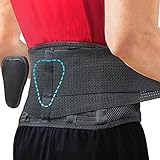


How the seven picks map to five buyer types
Nobody buys a lumbar support for fun. You buy one because something specific hurts at a specific moment, and that moment decides the brace. I sorted these seven listings by the buyer they suit rather than by brand, because brand tells you almost nothing here.
- The larger-waisted man. One pick states a 50" to 70" range and one states 54"-63". Everything else here is a Large, and Large runs out fast.
- The lifter. Repeat bending calls for rigid stays. Mueller cites 4 steel springs, changenow cites 4 memory support stays, FEATOL cites 4 support strips plus a lumbar pad.
- The sloucher. If your ache comes from eight hours in a chair, a belt alone does nothing for your shoulders. BraceTop is the only pick built around shoulder and chest positioning.
- The first-timer. You want something you'll actually wear. Sparthos and Bodyprox both pitch a slim profile under clothing.
- The occasional user. Two Saturdays a month in the yard. SOLOEVER covers that without extra parts.
One caution on the phrase "for men over 50": Amazon's own listings don't sort braces by age, and none of these seven publishes an age-specific design. What changes after 50 is usually waist measurement, stiffness in the morning, and how long you can tolerate compression. Judge those three yourself, then match them to the figures below. Age is a proxy. Fit is the fact.
What actually decides fit: waist number, not shirt size
Most guides to the best back brace for men over 50 compare padding and mesh. Padding is comfort. Fit is function, and a brace that slides upward gives you nothing at all.
Measure at your navel, not at your belt line. FEATOL's listing spells this out and it's the single most useful line in any of the seven listings: "measure your waist at the level of your navel, not your pants' size." Pants sizes lie by two to four inches for most men, and they lie in the direction that makes you buy a brace too small.
Here's the trick with plus sizing. Only two picks here publish a numeric waist window. Bodyprox covers 50"-70". FEATOL's 3XL covers 54"-63". That means a man measuring 66 inches at the navel has exactly one option in this set, which is why Bodyprox leads the ranking despite sitting at the cheaper end.
- Wrap a soft tape at navel level, standing normally, not sucking in.
- Add nothing for clothing. Braces go over a thin shirt at most.
- Compare against the published range, not the letter size.
- If you land within two inches of the top of a range, go up.
Weight matters too, and it's published for four picks. Bodyprox is the lightest of the four at 0.88 lb. Sparthos and changenow are both 0.9 lb. FEATOL and Mueller each come in at 1 lb. That's a small spread, but a 1 lb belt with steel springs feels very different at hour six than a 0.88 lb wrap does.
1. Bodyprox Lumbar Support Back Brace for Men and Women — Best overall
The only pick here that fits a 66-inch waist, and the lightest of the four picks that publish a weight.
Best for: a 50-inch-plus waist that most braces stop short of Skip it if: your waist sits under 50 inches
Fit range is the reason this one wins. The published window runs 50" to 70", which is wider than anything else in this group, and it's the only pick that keeps working past 63 inches. For a lot of men in their fifties and sixties, that single specification ends the search. Everything else on this page is a Large.
At 0.88 lb it is also the lightest of the four picks with a published weight, which matters if the brace is going on at breakfast and coming off after dinner. The model number is US-BackBrace-Plus. Bodyprox describes a dual-layer front compression strap with a dual side pull, and says the design is slim enough to wear under clothing while wicking sweat. Those are the brand's words, not a measured result, but the closure style is the practical difference: you pull both sides forward instead of reaching behind you, which is genuinely easier if bending already hurts.
The trade-off against the rest of the set is stated support hardware. Mueller names 4 steel springs, changenow names 4 memory stays, FEATOL names 4 strips plus a pad. Bodyprox's listing names none of that. You're buying fit range and low weight, not rigid bracing.
Pros:
- Widest published waist range here, 50" to 70"
- Lightest published weight of the four, 0.88 lb
- Front dual-pull closure, no reaching behind
- Brand claims slim enough for wear under clothing
- Cheaper than four of the six rivals
Cons:
- No rigid stays or support strips named in the listing
- Useless if your waist is under 50 inches
- No lumbar pad, unlike FEATOL and Sparthos
- Slowest seller of the seven picks
- Only one seller lists it
2. FEATOL Back Brace for Lower Back Pain — Best premium
The most hardware of any pick here: 4 support strips plus a removable lumbar pad, in a 54"-63" panel.

Best for: heavy lifting at a 54-63 inch waist Skip it if: you want something slim under a dress shirt
This is the most expensive pick here and it carries the most stated support. FEATOL lists 4 strong support strips plus an extra lumbar pad, and describes that combination as 360-degree support. It's also the one buyers choose most often in this set by a wide margin, which tells you the sizing chart is doing its job.
The 3XL version fits a 54" to 63" waist, and FEATOL publishes the smaller windows too: S/M covers 24.4"-29.8", L/XL covers 29.8"-38.6". That is more sizing transparency than any other listing here offers, and it removes most of the guesswork. Physical size is 2 x 10 x 9 in, weight 1 lb, which puts it in the heavier half of this group along with Mueller.
The 10-inch panel height is the real story for lifting. A taller panel spreads compression across more of the lumbar region instead of digging in at one band. FEATOL claims breathable fabric that avoids feeling hot or bulky. Treat that as the brand's claim.
The cost is bulk and price position. At 1 lb with a 10-inch panel and a pad, this is not the brace you wear under a fitted shirt to a wedding. It's the one you put on before you move furniture.
Pros:
- Most support hardware stated here, 4 strips plus pad
- Full published size chart from 24.4" upward
- 10-inch panel spreads load across the lumbar area
- Fastest-selling pick of the seven
- Removable pad allows two compression levels
Cons:
- Most expensive pick in this set
- Heaviest tier at 1 lb, tied with Mueller
- 2-inch depth is bulky under fitted clothing
- Top waist range stops at 63", below Bodyprox
- No shoulder straps for posture support
3. BraceTop Upgraded Posture Corrector Back Brace — Runner-up
The only pick here that addresses shoulders and lower back together, rather than just cinching your waist.

Best for: desk-bound slouching plus lower back ache Skip it if: you need a brace on and off all day
Sit for a living and your back pain often starts above the waist. BraceTop is the only pick in this group designed around that, describing what it calls 3-in-1 support for back, chest and shoulders with fully adjustable shoulder straps. That's a different job from every belt-only pick here.
The listed dimensions are 3.94 x 3.94 x 3.94 in packed, size Large, and the brand cites a high-elastic support strip in the newer version plus a perforated elastic band and a dense mesh back panel. The mesh is the sensible part of the design: strapping across your shoulders traps far more heat than a waist belt does, so airflow matters more here than in any other pick.
BraceTop states the design is unisex and suits both younger and older wearers. Useful, though it publishes no waist figure at all, which is a real gap when you're sizing a Large by guesswork.
Against the rest of the set, the honest weakness is convenience. Shoulder harnesses are slower to put on and take off than a front-pull belt, and there's no published weight to compare. If your pain is purely lumbar, a simpler belt does the job faster.
Pros:
- Only pick targeting shoulders, chest and lower back
- Fully adjustable shoulder straps
- Dense mesh back panel for airflow
- Widened belt for broader support coverage
- Brand states unisex fit across age groups
Cons:
- No published waist measurement or weight
- Harness takes longer to put on than a belt
- Premium price position, second-highest here
- More material against the skin in warm weather
4. Sparthos Back Brace for Women & Men — Best for beginners
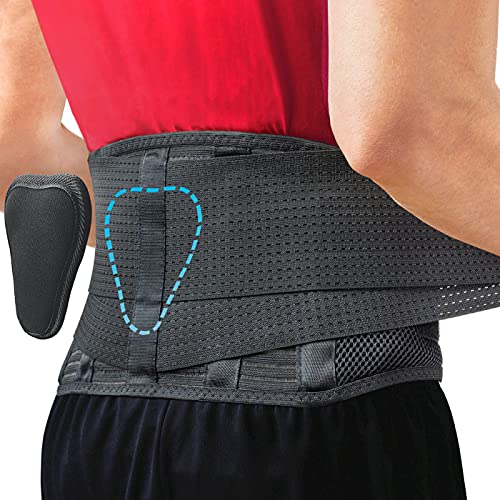
An adjustable lumbar pad at 0.9 lb, in the slimmest published profile of the padded picks.
Best for: a first brace worn under work clothes Skip it if: your waist is above the Large range
If you've never worn a lumbar support, the thing that stops you is self-consciousness, not pain. Sparthos is the pick built around that. It weighs 0.9 lb, measures 6.38 x 9.53 x 2.56 in, and the brand describes breathable fabric with an adjustable fit designed to wear under clothes.
The adjustable lumbar pad is the functional feature. It lets you dial compression at the sore spot instead of squeezing the whole waist evenly, which is the difference between wearing a brace for two hours and wearing it for twenty minutes. FEATOL has a pad too, but Sparthos pairs it with a 2.56-inch depth rather than FEATOL's 2 x 10 x 9 in footprint, so it sits closer to the body.
Sparthos's own copy leans hard on relief claims for herniated discs and sciatica. Those are the brand's claims, not clinical findings, and a first-time brace is exactly the situation where a doctor's input beats a listing bullet.
The trade-off is price against hardware. This sits in the priciest tier here, yet names no steel springs or support stays. Mueller costs less and states 4 steel springs. You pay Sparthos for comfort and discretion.
Pros:
- Adjustable lumbar pad for targeted compression
- Slim 2.56-inch depth, easiest of the padded picks to hide
- 0.9 lb, in the lighter half of this set
- Full dimensions published, unusual in this category
- Second-fastest seller of the seven
Cons:
- Premium price with no rigid stays named
- Large only, no published waist range
- Relief claims are unverified marketing copy
- Costs more than the stiffer Mueller
5. MUELLER Sports Medicine Lumbar Back Brace — Best for pros
Four steel springs make this the firmest stated support here, and the only pick with a published release year.

Best for: firm rigid support during repeat bending Skip it if: you want to forget you're wearing it
Steel, not memory foam. Mueller's model 255B lists 4 steel springs delivering firm targeted compression, and that puts it at the rigid end of this group. changenow uses memory stays and FEATOL uses support strips. Steel springs behave differently: they resist bending rather than simply reminding you not to.
It's a 2015 release, which is worth noting as consistency rather than staleness. Ten years on the same model number means the design hasn't needed reworking. Weight is 1 lb, dimensions 9.88 x 7.88 x 2.88 in, and the compression pad is removable, so you can run it stiff for a work shift and softer for the drive home. Mueller cites breathable mesh with odor-resistant treatment and adjustable wraparound closure straps.
Mueller also states more than 60 years in sports medicine. Treat brand heritage as context, not evidence of performance on your particular back.
The trade-off is exactly what you'd expect from steel. This is the least discreet pick in the set: 2.88 inches deep, 1 lb, and stiff by design. No shoulder straps and no published waist range either, so sizing is a leap.
Pros:
- 4 steel springs, firmest stated support here
- Removable compression pad, two stiffness levels
- Odor-treated breathable mesh
- Mid-priced, cheaper than the three premium picks
- Long-running model 255B, released 2015
Cons:
- Deepest profile at 2.88 in, hard to hide
- 1 lb, tied heaviest in this set
- No published waist range at all
- Steel springs limit bending comfort by design
- No shoulder strap option
6. SOLOEVER Work Back Brace for Men & Women — Best minimal setup
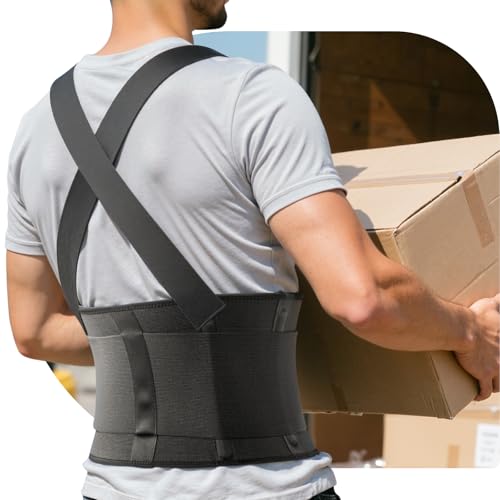
Suspenders on a cheap belt: the simplest way to stop a brace sliding during repeat lifts.
Best for: occasional garage or yard work Skip it if: you want published weight and size figures
The most common complaint about any waist belt is that it migrates north. SOLOEVER answers that with durable suspenders, which the brand says keep the brace securely in place. For anyone doing repeat bending in the yard or the garage, that one addition solves the actual failure mode.
It's the second-cheapest pick here and it sells quickly, which suggests the price and the suspender combination land well together. Size is Large, colour black, model Back Brace 001. The brand positions it for construction, landscaping and other repeated-motion work, and cites relief for back pain, sciatica and herniated discs. Those are marketing claims and should be read that way.
Here's the honest limitation. SOLOEVER publishes the least data of any pick in this group: no weight, no dimensions, no waist range. If you're between sizes or above a standard Large, you're buying blind, and a brace you can't size is a brace you may be returning.
Against the rest of the set, it also names no internal support structure. Four of the seven picks specify stays, springs or strips. This one specifies none.
Pros:
- Suspenders stop the belt riding up
- Second-cheapest pick in this set
- Sells quickly, so sizing is well trodden
- Positioned for repeat-motion work
Cons:
- No published weight or dimensions
- No waist range given for the Large
- No internal stays or springs named
- Suspenders add bulk under a shirt
7. changenow Medical-Grade Work Back Brace — Best budget pick
The cheapest pick here, and it still names 4 memory support stays plus dual shoulder straps.

Best for: warehouse shifts on a tight budget Skip it if: you need the widest waist coverage here
Cheapest of the seven, and it doesn't read like it. changenow lists 4 upgraded memory support stays, adjustable dual shoulder straps, a wider Velcro adhesive area and reinforced tension straps. On paper that's more named hardware than either premium-priced Sparthos or BraceTop offers.
Weight is 0.9 lb, which ties Sparthos and sits under the 1 lb of FEATOL and Mueller. Size is Large, model Back Brace 956. The brand describes durable mesh with skin-friendly fabric for airflow, and pitches it at lifting, warehouse, construction and moving work.
The words "medical-grade" and "orthopedic-grade" appear in the brand's copy. There's no certification behind that in the listing, so read it as positioning rather than a standard anything was tested against.
The trade-off is coverage and track record. There's no published waist range, so a Large is a gamble if you're near the edge. And it sells more slowly than four of the six rivals here, so there's less collective sizing wisdom to lean on than with FEATOL or Sparthos. Memory stays are also softer than Mueller's steel springs by nature.
Pros:
- Cheapest pick in this set
- 4 memory support stays plus dual shoulder straps
- 0.9 lb, in the lighter half here
- Wider Velcro area and reinforced tension straps
- Mesh construction for airflow during shifts
Cons:
- "Medical-grade" is unsupported brand language
- No published waist range or dimensions
- Memory stays are less rigid than steel springs
- Sells more slowly than four rivals here
Belt-only or shoulder straps: which does your day need?
This is the fork in the road, and it splits the seven picks cleanly in two. Four are belt-only: Bodyprox, FEATOL, Sparthos, Mueller. Three add straps over the shoulders: BraceTop, SOLOEVER and changenow.
Belt-only wins on speed and discretion. You wrap, you pull, you're done in five seconds, and a 2.56-inch profile like Sparthos hides under a shirt. If your brace goes on and off six times a day, that friction matters more than any support figure.
Straps win on two counts. First, they stop migration, which is why SOLOEVER's suspenders exist. Second, in BraceTop's case, they pull your shoulders back, and that's a different problem entirely from a sore lumbar spine.
- On and off all day, ache is low in the back. Belt-only. Bodyprox or Sparthos.
- One long stretch of lifting or bending. Straps. changenow or SOLOEVER.
- Slouching at a desk, sore between the shoulder blades too. BraceTop, and it's the only candidate.
- Maximum rigidity for a bad flare. Mueller's 4 steel springs, belt-only.
One warning. Shoulder straps sit on your traps, and if you carry a bag or wear a seatbelt for a long commute, that's a lot of pressure on one line. Test that before you commit to a harness for eight-hour days.
How long should you wear a back brace each day?
Nobody puts a wear-time figure on these listings, and that gap causes more trouble than any sizing error. A brace does part of your core's job. Ask it to do that job all day, every day, and the muscles it's covering for get lazier.
A workable pattern:
- Wear it for the specific task. Lifting, mowing, a long drive, the flare-up hours.
- Take it off when you sit down for the evening.
- Loosen it, don't just leave it on, if you're wearing it more than two hours straight.
- Track whether you're reaching for it more often over weeks. That's a signal to see a physiotherapist, not to tighten it further.
Removable pads help here. Mueller's compression pad and Sparthos's adjustable lumbar pad both let you drop the support level without taking the brace off, which is the middle setting most guides skip entirely.
Weight is the quiet factor in wear time. Over six hours, the 0.88 lb of the Bodyprox brace and the 1 lb of FEATOL or Mueller feel further apart than the figures suggest, mostly because heavier braces here are also the deeper ones. If you know you'll wear it long, the lighter, slimmer picks earn their place.
None of this replaces a doctor's guidance, and the "pain relief" and "medical-grade" language across these listings is marketing copy rather than clinical evidence. If pain is new, worsening or running down a leg, get it looked at before you buy compression.
What the listings do not tell you
Reading seven listings side by side, the gaps are as informative as the specifications. Three things you won't find here:
- Waist ranges, mostly. Only Bodyprox and FEATOL publish numeric windows. Five picks say Large and stop. That's a return risk you should price in mentally.
- Warranty terms. Not one of the seven publishes a warranty period. Sparthos writes about guaranteeing quality, but no duration appears anywhere in the data.
- Panel height. Only FEATOL's 10-inch figure tells you how far up your back the support reaches, and panel height determines whether a brace supports your lumbar spine or just squeezes your gut.
You'll also notice every pick comes in black only, and every pick is a single unit with one seller listing it. There's no multipack option here if you'd rather rotate two braces while one washes.
One more thing. The phrase "for men over 50" doesn't appear in a single one of these listings as a design criterion, and Amazon's search doesn't filter for it. Every pick here is sold as unisex. That's not a knock on the products; it just means you have to translate the age question into measurable requirements: waist at the navel, how many hours a day, and whether your shoulders need help too. Do that translation and the shortlist writes itself.
The verdict
The Bodyprox Lumbar Support Back Brace is the best back brace for men over 50 as a default pick, and the reason is arithmetic rather than design flair. Its 50" to 70" range is the only one in this set that keeps working past 63 inches, it's the lightest of the four picks with a published weight at 0.88 lb, and it sits at the cheaper end while doing it. For the large share of men in this bracket whose waist has moved since their forties, that's the whole decision.
Two conditions flip it. If you lift regularly and measure between 54 and 63 inches, take the FEATOL Back Brace instead: 4 support strips plus a lumbar pad and a 10-inch panel give you real load-spreading that Bodyprox's listing simply doesn't claim. And if your pain is as much shoulder and upper back as lumbar, BraceTop is the only pick here built for that, with fully adjustable shoulder straps and a dense mesh back.
A third flip, for the price-sensitive: changenow is the cheapest pick and still names 4 memory support stays and dual shoulder straps, which is more stated hardware than either premium belt-only option offers. If money is the constraint and you fit a Large, start there.
FAQ
What is the best back brace for men over 50 overall?
The best back brace for men over 50 overall is the Bodyprox Lumbar Support Back Brace. Its published 50" to 70" waist range is the widest in this group of seven, and at 0.88 lb it's the lightest pick that lists a weight. That combination suits long wear at a larger waist, which is the common case in this age bracket.
Is a premium back brace worth it over a budget one?
A premium back brace is worth it when the extra money buys named hardware you'll actually use. FEATOL, the most expensive pick here, lists 4 support strips, a removable lumbar pad and a 10-inch panel. But changenow, the cheapest, lists 4 memory stays and dual shoulder straps. If you fit a Large and don't need FEATOL's published size chart, the budget route holds up.
How do I know which size back brace to buy?
To know which size to buy, measure your waist with a soft tape at navel level, not by your pants size. FEATOL's listing spells out its ranges: S/M covers 24.4"-29.8", L/XL covers 29.8"-38.6", and 3XL covers 54"-63". Bodyprox covers 50"-70". If you land within two inches of a range's top, size up.
Bodyprox or FEATOL: which should I pick?
Choose between Bodyprox and FEATOL on waist measurement first. Bodyprox spans 50"-70" at 0.88 lb and uses a front dual-pull closure, so it's the pick above 63 inches and the easier one for all-day wear. FEATOL's 3XL covers 54"-63" with 4 support strips, a lumbar pad and a 10-inch panel, making it stronger for repeat heavy lifting.
What mistake do first-time back brace buyers make?
The mistake first-time buyers make is wearing the brace constantly instead of for specific tasks. A support belt does part of your core's work, so all-day use can leave those muscles doing less. Wear it for lifting, driving or flare-ups, loosen it after a couple of hours, and treat every "pain relief" claim in a listing as marketing rather than medical advice.
Start with the tape measure, not the product page. Get your navel-level measurement written down, then check it against the only two numeric ranges published in this set: 50"-70" for Bodyprox, 54"-63" for FEATOL's 3XL. If you clear 63 inches, the shortlist is one item long, and that's exactly why Bodyprox leads here. Under that, decide whether your day is one long lift or a dozen short ones, because that answer picks between straps and a plain belt faster than any brand comparison will. Then buy once and wear it for the task, not the whole day.