Best Budget Travel First Aid Kit for One Backpack

Piece count is the number every listing shouts about, and it's the wrong one to shop on. Thickness, weight and case type decide which travel first aid kit you'll actually carry. Six kits compared, with the flips that change the answer.

By Tanner TorresUpdated 17 min read
On this page
- Best budget travel first aid kit at a glance
- Why piece count is the wrong number to shop on
- How I cut a long list down to six kits
- 1. Prelady 152 Piece Small First Aid Kit — Best overall
- 2. General Medi Mini First Aid Kit — Best lightweight
- 3. Vriexsd Mini First Aid Kit — Best for heavy use
- 4. Protect Life Travel First Aid Kit for Car — Best for families
- 5. Aidehelp 165 Piece Mini First Aid Kit — Most versatile
- 6. BAND-AID Brand All-Purpose Portable Compact First Aid Kit — Best premium
- Soft pouch or hard shell: which should you carry?
- What does a budget travel first aid kit actually leave out?
- How thick can a kit be before it stops travelling?
- The verdict
- FAQ
The best budget travel first aid kit is the Prelady 152 Piece Small First Aid Kit, because at 0.6 in thick it slides flat against the back panel of a daypack while still carrying 152 pieces. If you want the lightest option instead, the General Medi Mini First Aid Kit weighs 5.6 oz and includes a foil blanket. Most shoppers compare piece counts across these listings and pick the biggest number. That's the wrong number. A 165-piece kit that sits 2.36 in deep gets left in the hotel room, and a kit in the hotel room treats nothing.
Best budget travel first aid kit at a glance
| Pick | Pieces | Thickness | Price |
|---|---|---|---|
Best overall Prelady 152 Piece Small First Aid Kit |
152 | 0.6 in | Check Price |
Best lightweight General Medi Mini First Aid Kit |
110 | 1.9 in | Check Price |
Best for heavy use Vriexsd Mini First Aid Kit |
150 claim | 2.76 in | Check Price |
Best for families Protect Life Travel First Aid Kit for Car |
100 | 1.5 in | Check Price |
Most versatile Aidehelp 165 Piece Mini First Aid Kit |
165 | 2.36 in | Check Price |
| 160 | 3.25 in | Check Price |


Why piece count is the wrong number to shop on
Piece count is the headline on all six of these listings. It's also the least useful figure in the set, because nobody publishes what the pieces are.
Consider the spread. The Protect Life kit lists 100 pieces. The Aidehelp lists 165. That's a 65-piece gap, which sounds enormous until you remember that a strip of ten identical small bandages counts as ten pieces. A kit can hit a big number on adhesive bandages alone and still leave you short on gauze.
Here's what the published data lets you compare honestly:
- Thickness, which decides whether the kit lies flat or blocks a pocket. The range here runs from 0.6 in to 3.25 in.
- Weight, where it's stated. General Medi lists 5.6 oz, Aidehelp 0.7 lb, Band-Aid 1.19 lb.
- Case type, soft pouch versus hard shell, which changes how the kit survives being sat on.
- Named contents, where the listing bothers to name them. Aidehelp says its 165 items include a tourniquet. Protect Life and General Medi both name a foil emergency blanket.
Named contents beat raw counts every time. A kit that specifies a tourniquet, a blanket and metal tweezers tells you more than a kit claiming 200 unnamed items. When you're choosing a budget travel first aid kit, read the named list and ignore the number on the front.
How I cut a long list down to six kits
I started from the compact travel category and cut on three grounds before ranking anything.
Cut one: no published dimensions. A travel kit whose listing skips size is unshoppable. Every kit here publishes all three dimensions, which is the only reason a thickness column exists in that table.
Cut two: full-size trauma bags. Anything built for a wall mount or a truck cab was out. The largest survivor, the Band-Aid kit, is 3.25 x 9.5 x 7 in, and that's already at the edge of what fits a packed bag.
Cut three: single-purpose kits. Burn kits, blister kits, sting kits. Useful, but not a general kit you carry once and forget.
That left six, and the ranking after that came down to how much kit you get per inch of bag space. The Prelady leads because 152 pieces in a 0.6 in profile is the best ratio in the group by a wide margin. General Medi follows on weight. The three hard-shell kits follow on durability and named contents. The Band-Aid kit sits last on portability and first on brand-name medicines, which is a real trade rather than a failing.
One note on the search itself. "Budget" is not a specification any of these listings publish, so I've ranked by price position within this set rather than against any outside threshold. Two picks sit at the entry positions here, two in the middle, two at the top. What counts as budget for your trip is your call, and the Check Price links carry the current numbers.
1. Prelady 152 Piece Small First Aid Kit — Best overall
A 0.6 in profile with 152 pieces inside is the best space-to-supplies trade in this group, and it's the cheapest of the six.
Best for: one carry-on or a daypack where thickness is the constraint Skip it if: the kit will live in a wet boat locker or a tool bag
Nothing else here comes close on thickness. At 5.95 x 7.8 x 0.6 in, this kit is thinner than a paperback and roughly the footprint of a tablet. It slides into a laptop sleeve, a seat-back pocket or the flat back compartment of a daypack, which are exactly the spaces the hard-shell kits can't use. The next thinnest pick, Protect Life, is 1.5 in, so the Prelady is under half the depth.
That flat shape comes from a soft case, and 152 pieces in a soft case means the contents share space rather than sitting in moulded slots. Prelady describes it as a purse and glovebox kit as much as a travel one, which matches the shape. The listing also claims TSA approval, and it's worth knowing that's the manufacturer's wording rather than a certification you can look up; screening decisions still sit with the officer at the belt.
The trade against the rest of the set is protection. There's no hard shell and no waterproof claim here, so a wet locker or a bag full of tools will punish it. It's also the slowest seller of the six, and only one seller lists it.
Pros:
- Thinnest kit here at 0.6 in
- 152 pieces despite the flat profile
- Cheapest pick in this set
- Fits flat pockets the hard cases can't
- Footprint under 6 x 8 in
Cons:
- Soft case with no waterproof claim
- No published weight figure
- Slowest seller of the six
- Only one seller lists it
2. General Medi Mini First Aid Kit — Best lightweight
At 5.6 oz this is the lightest kit in the group, and it still names a foil emergency blanket and scissors.

Best for: hikers counting ounces who still want a foil blanket Skip it if: you need a rigid case that won't crush
Weight is where this one wins. 5.6 oz is less than half the Aidehelp's 0.7 lb and well under a third of the Band-Aid kit's 1.19 lb. If you're carrying the kit on your back all day rather than in a car, that gap is the whole argument. The pouch measures 5.1 x 7.1 x 1.9 in, so it's compact in footprint too, though the 1.9 in depth means it wants a main compartment rather than a flat pocket.
Contents are the second reason to look. General Medi names an emergency foil blanket and scissors in the title, which are the two items cheap kits quietly drop. A foil blanket is a heat-retention sheet for shock or exposure, and it weighs almost nothing. Scissors matter because tearing tape with your teeth in the rain is how a small problem becomes a bigger one. The listing also says the products carry a certificate of conformity, which is the brand's claim, not something published in the specifications.
Piece count is the weak spot: 110 is second-lowest here, and 42 fewer than the Prelady at a higher price position. The soft pouch also offers no impact protection.
Pros:
- Lightest in the set at 5.6 oz
- Names a foil blanket and scissors
- Second-cheapest pick here
- Compact 5.1 x 7.1 in footprint
Cons:
- Only 110 pieces, second-lowest of the six
- 1.9 in depth won't fit flat pockets
- Soft pouch offers no crush protection
- Listing gives two different weight figures
3. Vriexsd Mini First Aid Kit — Best for heavy use
The waterproof EVA hard shell and labelled compartments make this the kit to buy if it gets opened weekly rather than annually.

Best for: a kit that gets opened often and lives in a trunk or pannier Skip it if: your bag has no room for a 2.7 in block
This is the only black case in the group, and the only one Vriexsd describes as waterproof EVA with hardness deliberately increased. EVA is a closed-cell foam shell that shrugs off knocks and light water, which is the right build for a kit riding in a bike pannier or a boat locker. Vriexsd also says the case carries labelled sleeves in separate compartments, and that's the feature that pays off on the tenth use rather than the first. A kit you can restock item by item stays stocked.
Named contents include gloves, povidone-iodine prep pads and metal tweezers. Metal tweezers over plastic is a genuine difference when you're digging out a splinter. The brand states 0.73 lb and adds bonus carabiners, so it clips to a pack loop.
Two things to weigh. At 2.76 x 6.49 x 4.92 in this is a block, not a flat pouch, and it eats bag volume the Prelady doesn't. The count is a claim of 150-plus rather than a firm figure, which makes it hard to compare against the Aidehelp's stated 165. It's also mid-priced here without the tourniquet or brand-name medicines the pricier picks name.
Pros:
- Only waterproof EVA hard shell described as reinforced
- Labelled compartments for restocking
- Names metal tweezers and iodine pads
- Includes carabiners for pack clipping
Cons:
- 2.76 in deep, bulky for a carry-on
- Piece count stated as a 150-plus claim
- No firm weight in the published specifications
- Only one seller lists it
4. Protect Life Travel First Aid Kit for Car — Best for families
The printed first aid guide is the reason this one wins for shared use, because the person who grabs the kit may not be the person who bought it.

Best for: one shared kit for a car plus a printed guide for whoever grabs it Skip it if: you want the smallest possible footprint
Protect Life includes a written first aid guide, and among these six only this kit names one. That matters more than it sounds. A family kit gets opened by a teenager, a grandparent or a neighbour, and a booklet showing how to dress a burn is worth more in that moment than twenty extra bandages. Protect Life describes the guide as doctor written; treat that as the brand's description rather than a verified credential, and note that the guide is a reference sheet, not medical advice.
The case is 1.5 x 7.5 x 5.2 in, so it's the second-thinnest here behind the Prelady while still being described as a rugged waterproof hard case. That combination is unusual. Most of the hard-shell kits in this group pay for their toughness in depth, and this one mostly doesn't. Contents named include a thermal emergency blanket, gauze, antiseptic wipes, gloves and scissors.
The count is the lowest of the six at 100 pieces, 65 behind the Aidehelp, and it sits in the middle of the price positions here. No weight is published, which is awkward for backpackers. On the upside it sells faster than the rest of this set apart from the Band-Aid kit, and two sellers stock it.
Pros:
- Only pick naming a printed first aid guide
- Hard waterproof case at just 1.5 in thick
- Names a thermal blanket and scissors
- Second-fastest seller in this group
Cons:
- Lowest piece count of the six at 100
- No published weight figure
- Mid price position for the fewest pieces
- 7.5 in long footprint eats pocket space
5. Aidehelp 165 Piece Mini First Aid Kit — Most versatile
165 pieces including a named tourniquet, in a 0.7 lb hard shell, is the widest injury coverage in this group.
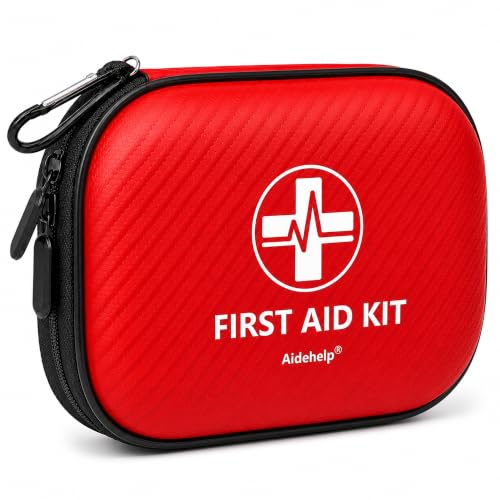
Best for: road trips and sports bags where a tourniquet matters Skip it if: you're buying purely on price position
The highest count here is 165, and Aidehelp is the only brand in the set that names a tourniquet among its contents. A tourniquet is a strap used to compress a limb and slow severe bleeding, and it addresses a category of injury the other five kits don't mention at all. If you drive long distances, run trail events or coach contact sport, that single item changes what the kit is for. It also needs training to use properly, so read the instructions before you need them.
Build is EVA hard shell, which Aidehelp calls impact-resistant and lightly water-resistant. Note that wording carefully. "Lightly water-resistant" is a weaker claim than the plain "waterproof" Vriexsd and Protect Life use, and the difference is the brand's own. Divided compartments are stated, and the published figures are 6.69 x 5.12 x 2.36 in at 0.7 lb, which makes it lighter than the Vriexsd despite carrying more items.
The cost is price and bulk. This sits in the top price positions here, and 2.36 in of depth is real bag space. Gloves and antiseptic pads are named, but no printed guide is mentioned, and only one seller lists it.
Pros:
- Highest count in the set at 165 pieces
- Only pick naming a tourniquet
- Lighter than the other hard shells at 0.7 lb
- Divided compartments for fast access
Cons:
- 2.36 in deep, awkward in a packed carry-on
- Water resistance described only as light
- Premium price position with no printed guide
- Only one seller lists it
6. BAND-AID Brand All-Purpose Portable Compact First Aid Kit — Best premium
The only kit here that names the medicines inside, and the only one you can refill from a supermarket shelf.

Best for: a home base kit stocked with named brand medicines Skip it if: the kit has to fit a packed carry-on
Every other kit in this set says "antiseptic wipes" and leaves it there. Band-Aid names its contents: Neosporin antibiotic cream, Benadryl Extra Strength for itching from bites or rashes, and Tylenol for temporary pain relief. Knowing exactly what's in the case matters when you're deciding whether to open it, and it means restocking is a trip to any pharmacy rather than a guess. The brand also notes its adhesive bandages are not made with natural rubber latex, which is the kind of detail generic kits skip entirely.
This is the fastest seller of the six by a wide margin, two sellers stock it, and it lists a 2022 release with a full model number. The 160 pieces come in a durable plastic case that Band-Aid says you can refill.
The problem for travel is size. 3.25 x 9.5 x 7 in makes this the largest kit here by every dimension, more than five times the Prelady's depth, and 1.19 lb makes it the heaviest. That's a medicine cabinet or car boot kit that happens to be portable, not a kit you carry on your back. It's also the most expensive pick in this set, and it names no emergency blanket, no tweezers and no tourniquet.
Pros:
- Only kit naming its exact medicines
- Refillable case from standard pharmacy stock
- Bandages not made with natural rubber latex
- 160 pieces with a published 2022 release
- The kit buyers choose most often here
Cons:
- Largest in the set at 3.25 x 9.5 x 7 in
- Heaviest at 1.19 lb
- Most expensive pick here
- No blanket, tweezers or tourniquet named
Soft pouch or hard shell: which should you carry?
Case type splits this group cleanly in half. Prelady and General Medi are soft; Vriexsd, Protect Life, Aidehelp and Band-Aid are rigid.
Soft pouches conform. That's the whole benefit. A zip pouch squashes into whatever gap is left in the bag, and it's how the Prelady gets to 0.6 in. The cost is that contents get compressed, blister packs crease, and nothing protects a glass ampoule or a plastic scissor handle from a heavy boot.
Hard shells hold their shape, which keeps compartments usable and stops contents shifting into a jumble. The cost is that a hard case takes its full volume whether it's full or empty. A 2.76 in block is 2.76 in of your bag even when half the sleeves are bare.
The rule I'd use:
- Carry-on and daypacks: soft. Space is the constraint, and the kit rides inside padding anyway.
- Car, boat, pannier, tool bag: hard. Water, grit and crushing are the real threats.
- One kit for everything: hard, at the thinnest profile you can find. Protect Life's 1.5 in case is the compromise pick here.
What does a budget travel first aid kit actually leave out?
Reading these six listings side by side, the same gaps show up over and over. A budget travel first aid kit is built around minor wounds, and here's what generally isn't there.
- Prescription medicine. None. Pack your own, in the original labelled packaging.
- Anything for a serious break. No splints named in any of the six.
- Instructions, mostly. Only Protect Life names a printed guide.
- Expiry dates. No listing publishes them. Creams and pain relief in a kit that sits in a hot car for two summers need checking.
- Quantities per item type. You're told 152 or 165 pieces, never how many are gauze pads.
What all six do cover is the realistic travel injury list: cuts, grazes, blisters, splinters, small burns and headaches. Three of them add a heat-retention layer, either a foil or thermal blanket. One adds a tourniquet.
The sensible move is to treat any kit here as a base and spend a few minutes adding the four or five things specific to your trip. Blister plasters for a walking holiday. Rehydration sachets for hot countries. Whatever antihistamine you actually tolerate. That takes a generic case and makes it yours, and it's cheaper than buying a bigger kit for items you'll never touch.
How thick can a kit be before it stops travelling?
Thickness is the figure I'd write on the back of my hand before shopping. It decides where the kit lives, and where the kit lives decides whether it's with you when something happens.
The practical thresholds:
- Under 1 in: goes anywhere. Flat back panel of a daypack, laptop sleeve, seat-back pocket, glovebox. Only the Prelady clears this at 0.6 in.
- 1 to 2 in: main compartment of a bag, no argument. Protect Life at 1.5 in and General Medi at 1.9 in sit here.
- 2 to 3 in: you're choosing this over something else. Aidehelp at 2.36 in and Vriexsd at 2.76 in are car and pannier kits first.
- Over 3 in: it's a base kit. The Band-Aid case at 3.25 in stays in the boot or the cupboard.
Footprint matters too, and it moves independently of depth. The Band-Aid kit is 9.5 in long, which is longer than a sheet of A5 and awkward in almost any daypack. The Prelady is 7.8 in on its longest side.
So the cutoff for a genuine one-bag trip is roughly 2 in of depth and 8 in of length. Above both, the kit becomes something you leave behind and mean to come back for.
The verdict
Split this by what you're willing to spend, because the three price tiers in this group buy three genuinely different things.
At the entry positions, you're buying portability. The Prelady 152 Piece Small First Aid Kit is the best budget travel first aid kit here and my default recommendation, because 152 pieces at 0.6 in thick beats every other space-to-supplies ratio in the set, and it's the cheapest pick too. The General Medi kit alongside it trades 42 pieces for the lowest weight in the group at 5.6 oz and a named foil blanket, which is the right swap if the kit rides on your back all day.
In the middle, you're buying a case. Vriexsd's reinforced waterproof EVA shell with labelled sleeves is built for a kit that gets opened weekly, and Protect Life packs a hard waterproof case into just 1.5 in while being the only pick with a printed guide, which makes it the family choice.
At the top, you're buying named contents. Aidehelp gives you 165 pieces and the only tourniquet here at 0.7 lb, and Band-Aid names its Neosporin, Benadryl and Tylenol so you know exactly what you're carrying. Both cost you bag space: 2.36 in and 3.25 in respectively.
The cutoff is simple. Under 2 in of depth, it travels. Over 3 in, it stays home.
FAQ
Is a budget travel first aid kit worth buying at all?
A budget travel first aid kit is worth buying if you'll actually carry it, and the compact ones here make that likely. All six cover the same realistic ground: cuts, grazes, blisters, splinters and small burns. Assembling equivalent supplies loose in a bag costs more in effort and ends up scattered. The value is having gauze and gloves in one findable place.
What should I look for in the cheapest kits here?
In the cheapest kits, look past the piece count to three things: published dimensions, a stated weight, and named contents rather than vague categories. The Prelady publishes 5.95 x 7.8 x 0.6 in. General Medi publishes 5.6 oz and names a foil blanket and scissors. A listing that names specific items is telling you more than one shouting a bigger number.
Prelady or General Medi: which small kit should I pick?
Prelady or General Medi comes down to shape versus weight. Prelady carries 152 pieces in a 0.6 in profile, so it fits flat pockets nothing else here can use, and it's the cheapest of the six. General Medi weighs 5.6 oz, the lightest figure in this group, and names an emergency foil blanket. Flat bag space, Prelady. Ounces on your back, General Medi.
Will these kits fit in a carry-on bag?
These kits will fit a carry-on with two exceptions worth checking. Prelady at 0.6 in, Protect Life at 1.5 in and General Medi at 1.9 in all disappear easily. Aidehelp at 2.36 in and Vriexsd at 2.76 in take real volume. The Band-Aid case at 3.25 x 9.5 x 7 in is a base kit. Scissors and tweezers are subject to airline screening rules.
What mistake do most first aid kit buyers make?
Most first aid kit buyers chase the highest piece count and end up with a case too bulky to carry. The 65-piece gap between the 100-piece Protect Life and the 165-piece Aidehelp is largely identical adhesive bandages. Buy on thickness and named contents, then add the four or five items specific to your trip yourself.
Start by measuring the space you actually have. Find the flattest gap in the bag you travel with, hold a tape to it, then compare that number against the thickness column above. Buy the kit that fits that gap rather than the kit with the biggest headline. For most people packing one bag, that's the Prelady, and the reason is boring: a kit that lives in the flat pocket you never use is a kit you never have to decide whether to bring. Then spend ten minutes adding the specific items your trip needs and check the creams once a year.