Best Extra Soft High Fidelity Ear Plugs: Fioobie Wins

Seven silicone and foam picks, ranked for side sleepers, shared rooms and travel bags. The winner claims 46dB. The runner-up ships 50 pairs. Here is which one fits which sleeper.

By Tanner TorresUpdated 16 min read
On this page
- Best extra soft high fidelity ear plugs for sleeping at a glance
- How I screened the shortlist
- Silicone or foam: which one actually seals for sleep?
- 1. Fioobie 2026 Pro Ear Plugs for Sleeping — Best overall
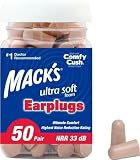
- 2. Mack's Ultra Soft Foam Earplugs — Runner-up
- 3. Yawsoy Ear Plugs for Concerts — Best for beginners
- 4. Anqva Ear Plugs for Sleeping Noise Cancelling Reusable — Best for heavy use
- 5. Loop Experience 2 Ear Plugs — Best compact
- 6. Eargasm High Fidelity Blue Earplugs for Concerts — Best premium
- 7. Ugopw Ear Plugs for Sleeping Noise — Best budget pick
- What "high fidelity" means once you close your eyes
- How many pairs will you actually get through?
- What to check before you click buy
- The verdict
- FAQ
The best extra soft high fidelity ear plugs for sleeping are the Fioobie 2026 Pro, thanks to a nano-silicone body Fioobie says is ASTM-tested to 46dB and a 360° pressure-balanced shape aimed at side sleepers. Most shoppers compare noise reduction figures and stop there, but fit decides a night of sleep, not headline decibels. If a shared room means you want a fresh pair every night, Mack's Ultra Soft Foam wins on a different axis: 50 pairs in one box, rated at 33dB.
Best extra soft high fidelity ear plugs for sleeping at a glance
| Pick | Noise reduction | Material | Price |
|---|---|---|---|
Best overall Fioobie 2026 Pro |
46dB (ASTM claim) | Nano silicone | Check Price |
Runner-up Mack's Ultra Soft Foam |
33dB NRR | Comfy Cush foam | Check Price |
Best for beginners Yawsoy High Fidelity |
18–25dB SNR (claim) | Ultra-soft silicone | Check Price |
Best for heavy use Anqva Reusable |
Not stated | Silicone | Check Price |
Best compact Loop Experience 2 |
Certified (unspecified dB) | Silicone shell | Check Price |
Best premium Eargasm High Fidelity |
21dB (NRR 16dB) claim | Hypoallergenic silicone | Check Price |
Best budget pick Ugopw High Fidelity |
18–25dB (claim) | Soft silicone | Check Price |



A note on the keyword. Amazon's search for "extra soft high fidelity" returned a mix that includes standard foam and standard silicone. None of these listings is marketed as extra soft high fidelity in a formal sense, so I have not claimed that of any single pick. Judge softness against your own ears.
How I screened the shortlist
Seven picks, one page of comparisons. I lined up every published specification the seven listings share: material, count, weight, dimensions, model number, and any stated noise-reduction figure. Then I read the feature bullets and marked which claims were quantified and which were adjectives.
Three picks publish a decibel figure with a testing standard attached: Fioobie names ASTM and 46dB, Mack's names NRR and 33dB, Eargasm names NRR 16dB with an "up to 21dB" claim. Two more (Yawsoy, Ugopw) state 18–25dB but do not attach a testing standard. Two publish no decibel figure at all in their specs (Anqva, Loop Experience 2). That gap alone reshuffles the ranking if all you care about is a documented number.
Set composition matters here. Four of the seven are silicone reusables. One is foam disposables. Two use a filter-plus-shell design aimed at concerts more than sleep. Only one, Mack's, ships in bulk. Only one, Fioobie, publishes a side-sleeper claim in its structural design. Those are the differences the table cannot show in a single row.
Silicone or foam: which one actually seals for sleep?
Foam expands into the canal and blocks broadband noise the hardest. Silicone shells hang in the outer ear and use a filter to shape what passes through. Both work for sleep. Neither is automatically better.
- Choose foam if you sleep on your back, want the deepest broadband seal, and do not mind rolling a fresh pair before bed.
- Choose silicone if you sleep on your side, want the same pair to last for months, and prefer washing to replacing.
- Choose a filtered silicone if you also wear plugs to concerts or on flights and want one pair to do both jobs.
The extra-soft angle in the keyword points at silicone. Foam is soft when it expands, but silicone plugs like the Fioobie and the Anqva sit in a lower-pressure position in the concha and load the ear less on a pillow. That is the real reason side sleepers gravitate to silicone. It is not always about decibels.
1. Fioobie 2026 Pro Ear Plugs for Sleeping — Best overall
The only pick here designed around side-sleeper pressure and backed by an ASTM decibel figure.
Best for: side sleepers who shift positions all night Skip it if: you burn through disposables and hate washing anything
Two things separate the Fioobie from the rest of the extra soft high fidelity ear plugs for sleeping in this set. First, Fioobie says the Pro AcousticWave filter is ASTM-tested to 46dB, which is the highest figure any pick here publishes with a standard attached. Second, the 360° pressure-balanced shape is the only structural claim in the group aimed specifically at side sleepers, which is where most sleep plugs fail. The pair weighs 22.7 g together and ships with 6 ear tips, so the fit adjustment is done in the box rather than in a follow-up order.
Fioobie also claims the nano silicone resists earwax and odours across 1000+ washes and lasts three times longer than standard foam in daily tests. Treat those as manufacturer claims, not measurements. What matters for the ranking is that the two things you want most in this category, a documented reduction figure and a shape built for a pillow, sit in the same product. The trade-off is count: two plugs, one pair. You will wash them.
Pros:
- Fioobie claims 46dB with ASTM testing named
- 360° pressure-balanced shape for side sleepers
- 6 ear tips in the box for fit tuning
- Nano-silicone body Fioobie says handles 1000+ washes
Cons:
- Only one seller lists it, so returns route through a single source
- No dimensions published, so case size is unknown
- Mid-range price position for a single pair
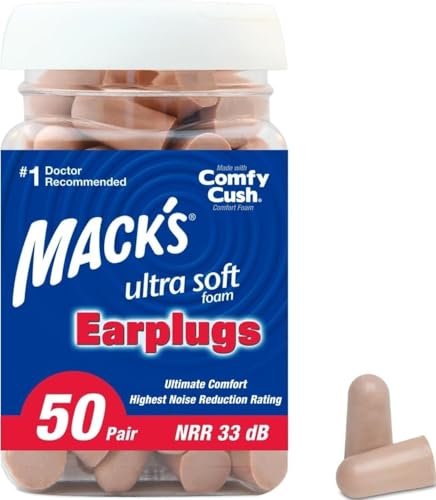
2. Mack's Ultra Soft Foam Earplugs — Runner-up
The only pick that ships in real bulk, and the only one with a documented NRR.
Best for: shared rooms where a fresh pair every night matters Skip it if: you want something reusable and washable
Mack's is the exception in the set. Every other pick is a reusable silicone or a filter-shell hybrid. Mack's is 50 pairs of low-pressure foam, weighing 1.59 oz in a 2.52 x 4.25 x 2.52 in box, rated at 33dB NRR. That NRR is a formal figure, unlike the "18–25dB" and "certified" language elsewhere. In practice, that means Mack's is the pick you compare against when someone tells you silicone is enough: 33dB NRR is a real ceiling.
The Comfy Cush foam is user-preferred beige, slow-release, and forgiving on the ear canal. For a partner who snores at close range, the foam density gets you further than a lightly filtered shell. It is also the second-cheapest pick here and sells faster than every silicone option in the group, which tells you how many buyers reach for foam once they have tried both.
Two things push it into runner-up. The plugs are single-use in practice, so waste piles up over a year. And a 33dB NRR blocks alarms and doorbells alongside the snoring. If you are the parent on night duty, that is a real cost.
Pros:
- 33dB NRR, the only formal NRR figure in the set
- 50 pairs per box for daily rotation
- Low-pressure Comfy Cush foam
- Two sellers list it, unusual in this group
Cons:
- Disposable, so the box turns into landfill
- Blocks alarms and children's voices at the same rate
- Beige colour is visible against a pillow
3. Yawsoy Ear Plugs for Concerts — Best for beginners
A gentle 18–25dB silicone pair that ships with 5 tip sizes and a lanyard case.

Best for: first-time silicone users who want spare tips in the box Skip it if: you need the deepest possible noise cut
The Yawsoy pack is a first silicone. Yawsoy states an 18–25dB SNR from professional audio filters and includes 5 pairs of S/M/L ear tips, a mini plastic storage case with lanyard, and a carabiner. That is a lot of fit adjustment for a beginner who does not yet know which tip size seats correctly. Weight is 16.3 g and the packaging measures 0.75 x 4.09 x 3.46 in.
The design is aimed at concerts, so the reduction is milder than the Fioobie by design. For sleep, that reads two ways. If you want to still hear a smoke alarm or a baby monitor, 18–25dB is the right ballpark. If you are trying to sleep through construction outside the window, it is not enough. Sound clarity is preserved evenly across frequencies, which Yawsoy calls high fidelity, and that is the feature that separates these from foam: you still hear the room, just quieter.
Trade-offs are honest. This is a premium-priced pick despite being aimed at beginners, and the sales rank sits well behind Mack's and Loop. The value is the tip kit and the case.
Pros:
- 5 pairs of S/M/L tips for fit trials
- Storage case, lanyard and carabiner included
- Yawsoy states 18–25dB SNR from audio filters
- Released 2024, so a current design
Cons:
- Mild reduction for anyone near heavy noise
- Premium price position for a two-pair pack
- Concert framing, not a sleep-first product
4. Anqva Ear Plugs for Sleeping Noise Cancelling Reusable — Best for heavy use
Three colour-coded pairs and two travel covers for households that share.

Best for: couples or roommates rotating three coloured pairs Skip it if: you want a published decibel figure to compare
Anqva is the only pick in the group that ships three pairs in three colours (black, white, blue) plus two silicone protective covers. That is the practical case for it. One pair lives by the bed, one lives in a travel bag, one is a spare or a partner's. Colour coding solves the "whose plugs are these" problem before it starts. The listing sits in the entry price band, which makes the rotation approach cheap to adopt.
The cost is transparency. Anqva does not publish a decibel figure, a weight, a dimension or a model number. The feature bullets mention "industry-leading noise reduction" without a value, which is the kind of claim that has to be discounted. Compared to Fioobie's 46dB and Mack's 33dB, that is a real gap.
Choose it when the household reason (multiple pairs, hygiene, colour coding) outweighs the specification gap. Skip it if you need to know exactly how much noise you are cutting before you buy.
Pros:
- Three pairs in one order at an entry price
- Two silicone protective covers for travel
- Colour options for shared households
- Reusable and washable silicone
Cons:
- No published decibel figure
- No published weight or dimensions
- Slowest seller of the seven listings
5. Loop Experience 2 Ear Plugs — Best compact
The lightest, lowest-profile shell in the set at 1.06 oz per pair.

Best for: travellers who carry plugs day and night Skip it if: you prefer a deeper seal over a low-profile shell
Loop Experience 2 is the most stylistically distinct pick here and the second most compact by dimension at 0.75 x 3.07 x 3.07 in. The pair weighs 1.06 oz. Loop says the plugs qualify as certified hearing protection, though the listing does not name a decibel figure the way Fioobie or Mack's do. Four upgraded ear tip sizes ship in the box, including a small size aimed at people who find most plugs loose.
The design brief is concerts and daily life, not deep sleep. For sleep, Experience 2 works best if you are a back sleeper or a light side sleeper: the shell sits flat enough that a pillow does not press it into the canal. The trade-off is depth of seal. A softer, deeper silicone tip (or foam) will cut low-frequency snoring more than a filtered shell.
It is the second-most expensive pick and the one buyers choose most often among the specialty silicones here, judging by category position. That combination of price and demand tells you the audience is buying it as an all-day plug rather than a sleep-only one.
Pros:
- 1.06 oz per pair, easy to carry
- Four ear tip sizes including small
- Certified hearing protection per Loop
- Low-profile shell for daily wear
Cons:
- No decibel figure published
- Filter shell seals less than foam on low frequencies
- Premium price for a single pair
6. Eargasm High Fidelity Blue Earplugs for Concerts — Best premium
Two shell sizes and an aluminium keychain case, for people who lose plugs.

Best for: buyers who want a metal case that lives on a keyring Skip it if: you want the highest claimed reduction here
Eargasm publishes NRR 16dB with an up-to-21dB claim across frequencies, plus two interchangeable shell sizes (standard and small) in hypoallergenic silicone. The differentiator is not the acoustic figure. It is the aluminium keychain case, which solves the single biggest reason people stop using reusable plugs: they lose them. For anyone whose plugs need to travel to work, to the gym and back to the bedside table, a metal case on a keyring is worth more than a decibel or two.
For sleep, 21dB is on the light end. It softens a partner's snoring and dulls traffic. It will not blank out heavy construction. The two shell sizes are the important spec for sleepers with smaller canals, because a poorly seated standard shell is what causes plugs to fall out mid-roll.
It sits at the top of the price ladder in this group. If you have already tried a cheaper silicone and stopped using it because it never followed you around, the case earns the position.
Pros:
- Aluminium keychain case included
- Two shell sizes for smaller ears
- NRR 16dB documented, plus 21dB claim
- Hypoallergenic silicone
Cons:
- The highest price position here
- Lower claimed reduction than Fioobie or Mack's
- Concert framing, not sleep-first
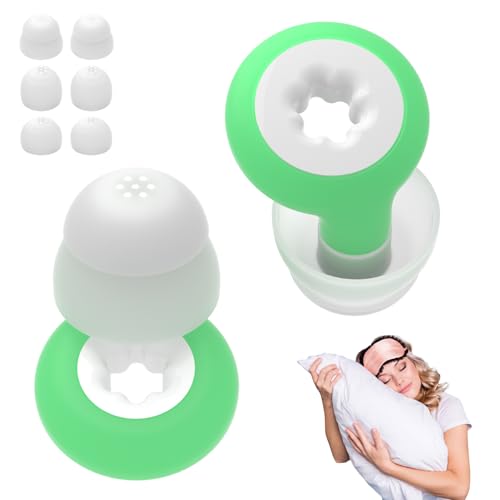
7. Ugopw Ear Plugs for Sleeping Noise — Best budget pick
The cheapest of the seven, with an 18–25dB claim and three tip sizes.
Best for: trying reusable silicone without commitment Skip it if: you want a documented ASTM or NRR figure
Ugopw is the cheapest of the seven and the entry point for anyone unsure whether reusable silicone is going to work for them at all. The pack contains 2 pairs plus 3 pairs of ear tips in S/M/L, weighs 18 g and comes in green. Ugopw states 18–25dB reduction, matching the Yawsoy figure without a standard attached.
The listing does most of its work on the framing. Ugopw talks specifically about night-shift workers sleeping during the day around household noise, which is a real use case that heavier plugs sometimes over-serve. A plug that dulls a TV in another room without silencing a doorbell can be exactly what a day sleeper wants.
The honest trade-off is transparency. Sales rank sits far behind every other pick in the set, and none of the noise-reduction claims are attached to a testing standard. Take it as a low-cost way to see whether silicone shells sit well in your ears before spending more on a Loop or Eargasm. If they do, upgrade. If they do not, you have not risked much.
Pros:
- The cheapest pick in the set
- 3 pairs of S/M/L tips in the box
- Reusable silicone for repeated wash
- Ugopw states 18–25dB reduction
Cons:
- No testing standard attached to the claim
- Slower selling than every other pick here
- No dimensions or model number published
What "high fidelity" means once you close your eyes
High fidelity plugs use a filter to reduce noise evenly across frequencies, so the sound coming through is quieter but still balanced. That is a concert idea. At a show, you want the vocals audible and the cymbals safe. In bed, the goal is different: you want the low rumble of a snore or a truck cut hardest, not preserved cleanly at lower volume.
That mismatch is why several picks in this set are marketed for concerts and rated 18–25dB. They keep the room legible while dropping the volume. If you sleep near a partner and still want to hear a child crying, that is the right trade. If you want to disappear, foam or the deeper-seal Fioobie serves you better.
How many pairs will you actually get through?
Rough numbers, from the counts each listing publishes:
- Mack's: 50 pairs. If you use one pair per night, that is around seven weeks. If you get two nights per pair, closer to fourteen weeks.
- Fioobie: one pair, washable. Fioobie says the silicone survives 1000+ washes, which even if optimistic points to months of nightly use.
- Anqva: three pairs, rotated. Effectively three months of steady wear before any pair gets tired.
- Loop, Eargasm: one pair each. Both are shell-and-filter designs meant to be cleaned and reused indefinitely.
- Yawsoy, Ugopw: two pairs each. A spare live in the drawer while the first pair works.
The purchase decision often runs on this axis alone. Mack's is the cheapest per night. Anqva is the cheapest for a two-person household. Fioobie is the cheapest if you actually get the wash count Fioobie claims. Loop and Eargasm cost more per pair, so their case hardware and fit kits have to earn the difference.
What to check before you click buy
- Sleep position. Side sleepers press whichever plug is on the pillow. A pressure-balanced or low-profile shell hurts less by morning than a deep-insert foam.
- What you want to still hear. A smoke alarm, a doorbell, a baby monitor, a partner's voice. A lower reduction figure keeps those in play. A higher one does not.
- Wash routine. Silicone plugs need weekly cleaning. If that is not a habit you will build, foam is honest.
- Tip sizes. Anyone with narrow canals should prefer a pick that ships small tips or a small shell. Fioobie ships six tips, Yawsoy five pairs, Loop four sizes, Eargasm two shell sizes.
- Storage. A case that lives with you is a plug that gets used. Eargasm's aluminium keychain, Yawsoy's lanyard case and Anqva's travel covers all solve this.
The verdict
Two paths, one cutoff. If you sleep on your side or share a bed with a snorer, buy the Fioobie 2026 Pro. It is the only pick that combines a documented decibel figure (46dB ASTM, per Fioobie) with a shape built around pillow pressure, and the six-tip fit kit means the first night is likely to be the right night. That is what makes it the best extra soft high fidelity ear plugs for sleeping choice for most buyers.
If your problem is bulk hygiene for a shared room, or you cannot bring yourself to wash silicone plugs, buy Mack's Ultra Soft Foam. Fifty pairs of 33dB NRR foam is a different value proposition, not a worse one. Fresh pair every night, no maintenance, formal NRR rating. The cutoff between the two is simple: if you would rewear the same pair for a week without thinking, choose Fioobie. If that idea bothers you, choose Mack's.
Everything else in the set solves narrower problems. Eargasm's keychain case for chronic losers. Loop for daily carry. Anqva for households. Yawsoy and Ugopw for cheap silicone trials. Pick the constraint that describes you, then buy the plug that names it in its bullets.
FAQ
Are the best extra soft high fidelity ear plugs for sleeping actually different from concert plugs?
The best extra soft high fidelity ear plugs marketed for sleep often share the same silicone shell and filter as concert plugs, so the physical difference is small. What changes is the tip depth, the pressure profile and the reduction target. Sleep-first designs like Fioobie's 360° pressure-balanced shape aim to survive a pillow, while concert-first plugs like Loop Experience 2 keep sound quality intact at lower volume.
Is Fioobie worth it over cheaper silicone picks?
Is Fioobie worth it depends on your sleep position. Fioobie is mid-priced in this set, not premium, and it is the only pick here that publishes 46dB with ASTM named and a side-sleeper structural claim. If you sleep on your back and share a quiet room, cheaper silicone from Yawsoy or Ugopw covers the need at 18–25dB. If a partner snores or you shift sides, Fioobie earns the position.
How does 33dB NRR compare with a 46dB claim?
How does 33dB NRR compare in practice: NRR is a US-standard rating measured under laboratory conditions, while 46dB from Fioobie is stated against ASTM testing without an NRR figure. The two numbers are not directly interchangeable. Treat NRR as a conservative real-world floor and manufacturer decibel claims as a ceiling. For sleep, both figures are more than enough for household noise.
Fioobie vs Mack's for a snoring partner?
Fioobie vs Mack's comes down to reusability. Mack's foam expands into the canal and delivers 33dB NRR per pair, so it blocks low-frequency snoring aggressively for one night before you toss it. Fioobie's nano-silicone sits shallower but claims 46dB with ASTM testing and lasts many washes. For the partner problem, Mack's if you want fresh nightly, Fioobie if you want one pair for months.
What is the most common mistake buying sleep earplugs?
The most common mistake buying sleep earplugs is choosing on decibel figure alone and skipping the tip size. A plug rated 46dB that does not seal delivers less than a 21dB plug that does. Every pick here except Mack's ships multiple tip sizes for a reason. Try the medium first, then size down if the plug slips or up if the seal feels loose after ten minutes.
Start with the Fioobie 2026 Pro if you are on the fence. It sits mid-range in this set, ships with six tips so the first-night fit is likely, and pairs the highest published decibel figure with the only side-sleeper structural claim in the group. If it does not work for your ears, the six-tip kit tells you why (usually a tip size issue), and Mack's foam is the honest backup for anyone who would rather grab a fresh pair from a box than clean silicone before bed. Buy for the constraint that describes your bedroom, not the number on the front of the packet.