Best LED Face Mask for Large Pores: INIA Leads

Five LED face masks, ranked by wavelength coverage, LED count and power density. The INIA leads on paper, but three named conditions flip the pick.

By Tanner TorresUpdated 13 min read
On this page
- Best LED face mask for large pores at a glance
- What actually decides an LED mask for pore-focused skin
- 1. INIA Red Light Therapy Mask for Face — Best overall
- 2. GIHWRRI FDA-Cleared LED Light Therapy Mask — Best upgrade
- 3. Shark CryoGlow LED Face Mask — Best premium
- 4. wavytalk Red Light Therapy Mask for Face — Best minimal setup
- 5. gelpal 7-1 Colors Red Light Therapy For Face — Best budget pick
- Wavelengths, LED counts and power density compared
- Does an LED face mask really shrink large pores?
- What the listings do not tell you about session time
- Who should skip an LED mask entirely?
- The verdict
- FAQ
The best LED face mask for large pores is the INIA Red Light Therapy Mask, thanks to 220 LED chips, dual 630nm and 850nm wavelengths, and a claimed 105mW/cm² output that beats every other power figure in this set. If you want a soft silicone fit and seven colour options instead of a rigid shell, the GIHWRRI FDA-Cleared LED Light Therapy Mask is the better buy. Note upfront: none of the five listings publish pore-size clinical data, so treat "large pores" as an appearance goal, not a promise.
Best LED face mask for large pores at a glance
| Pick | LED count | Wavelengths | Price |
|---|---|---|---|
Best overall INIA Red Light Therapy Mask |
220 chips | 620nm, 630nm, blue, 850nm NIR | Check Price |
Best upgrade GIHWRRI FDA-Cleared LED Mask |
70 chips | 7 colours claim | Check Price |
Best premium Shark CryoGlow LED Face Mask |
not listed | Red, blue, deep infrared | Check Price |
Best minimal setup wavytalk Glow Time LED Mask |
456 chips | 415nm, 590nm, 630nm, 850nm | Check Price |
Best budget pick gelpal 7+1 Colors LED Mask |
90 beads | 7 colours claim | Check Price |



What actually decides an LED mask for pore-focused skin
Most pore-focused shoppers compare colour counts. Seven colours sounds like more coverage than four, so it must be better. That is not what decides it. Two figures do: the actual wavelengths on offer and the power density measured in mW/cm² at the skin.
Pore appearance responds to two things an LED mask can plausibly influence. Red and near-infrared light in the 630nm and 850nm bands are the wavelengths that manufacturers link to collagen support, and firmer skin around a pore is what makes the opening look smaller. Blue light in the 415nm range targets the bacteria involved in the breakouts that stretch pores in the first place. Yellow, green, cyan and purple channels are marketing volume, not evidence.
Power density decides how much of that light actually reaches the dermis. INIA claims 105mW/cm². Wavytalk claims 40mW/cm². The other three do not publish a figure. That single specification, more than colour count, separates a serious device from a mood light.
Here is what to check before you buy:
- The specific wavelengths, in nanometres, not the colour names
- A published power density figure with the mW/cm² unit
- LED count high enough to cover the face evenly
- Session length that matches your actual routine
- Fit that lets you use it as often as the instructions require
1. INIA Red Light Therapy Mask for Face — Best overall
INIA is the pick because it stacks the highest published LED count and power density in this set with the two wavelengths that matter for pore-focused skin.
Best for: combination skin wanting the highest LED count in this set Skip it if: you want a soft silicone mask you can wear while moving around
INIA lists 220 LED chips against wavytalk's 456 and GIHWRRI's 70. On chip count alone it sits in the middle, but INIA is the only pick that pairs both 630nm red and 850nm near-infrared with a published 105mW/cm² output. Wavytalk publishes 40mW/cm², which is the only other real number in the set. That is a claimed 2.6-times power gap at the skin.
The four modes give you 620nm, 630nm, blue and 850nm channels, so you can run a blue-light pass for active breakouts and switch to red plus infrared for the firming work that makes pores look tighter. INIA says the 2600mAh controller runs the full routine without a wall tether. The trade-off is a rigid shell rather than the flexible silicone body the GIHWRRI and wavytalk masks use. Sitting still for a session is fine; walking around during one is not.
Pros:
- Highest published power density in this set at 105mW/cm²
- Both 630nm red and 850nm near-infrared included
- Four modes covering red, blue and NIR
- Cordless with a 2600mAh controller
- Mid-price position for premium-tier specs
Cons:
- Rigid shell rather than flexible silicone
- No published weight or dimensions
- Only one seller lists it, which limits shopping around
2. GIHWRRI FDA-Cleared LED Light Therapy Mask — Best upgrade
GIHWRRI earns the upgrade slot for pairing a soft silicone body with an FDA-cleared claim and seven wavelength channels.

Best for: shoppers who want seven wavelengths and a flexible silicone fit Skip it if: you only care about red and near-infrared and want the strongest output
The GIHWRRI mask weighs 0.99 lb and measures 0.8 x 11.6 x 7.3 in, which are the kind of published fit figures the INIA and gelpal listings never give you. GIHWRRI says the silicone contours to any face shape with zero pressure points, and the brand calls the device FDA-cleared. That is a listing claim, not a specification you can measure, so verify the current cleared-device status on the FDA database before you commit if that matters to you.
Seventy LEDs is the lowest chip count of the four picks that publish one. That is the honest cost of the flexible silicone build: you lose density to gain fit. GIHWRRI says the mask covers seven therapeutic wavelengths including red for collagen and blue for breakouts, and runs eight to twelve sessions per charge. Against INIA, the trade is real. You give up the 105mW/cm² output figure and settle for four to five colours you will actually use, but you get a mask that stays put while you move.
Pros:
- Soft silicone body with published dimensions
- FDA-cleared claim per the listing
- Rechargeable, eight to twelve sessions per charge claim
- Entry-tier price position for the feature set
- Seven wavelength channels on offer
Cons:
- Only 70 LEDs, the lowest chip count in this set
- No published power density figure
- Slowest seller in this group
3. Shark CryoGlow LED Face Mask — Best premium
Shark takes the premium slot for adding under-eye cooling to the standard red, blue and infrared LED lineup.

Best for: buyers who want under-eye cooling built into the same device Skip it if: your budget sits at the entry end of this set
The CryoGlow is the only pick in this set that pairs LED therapy with an active cooling zone. Shark bills it as red, blue and deep infrared LED with under-eye cooling, and the listing names four preset treatments developed with dermatologists: Better Aging, Skin Clearing, Skin Sustain, and Under-Eye Revive. Model FW312PL, released in 2025, weighs 1.49 lb, so it is the heaviest of the three picks that publish a weight.
For a pore-focused shopper, the relevant channel here is the Better Aging treatment. Shark says it runs six minutes on the red and infrared LEDs and has been clinically tested on 119 participants by an independent third party. That is a specific figure worth noting, though the listing does not publish a power density number, so you cannot compare its output against INIA's 105mW/cm² claim directly. The premium price is the honest cost. You pay it for the cooling add-on and the four-treatment preset library, not for extra LED power.
Pros:
- Only pick with under-eye cooling built in
- Four preset treatments including a six-minute red and infrared routine
- 2025 model with a stated third-party clinical test
- Two sellers stock it, which helps availability
Cons:
- Highest price position in this set
- No published LED count or power density
- Heaviest of the picks that publish a weight, at 1.49 lb
4. wavytalk Red Light Therapy Mask for Face — Best minimal setup
Wavytalk keeps the operation simple: three preset modes, one silicone body, and the highest published chip count in this set.
Best for: someone who wants three preset modes and a silicone fit with eye pads Skip it if: you want blue light or seven-colour options
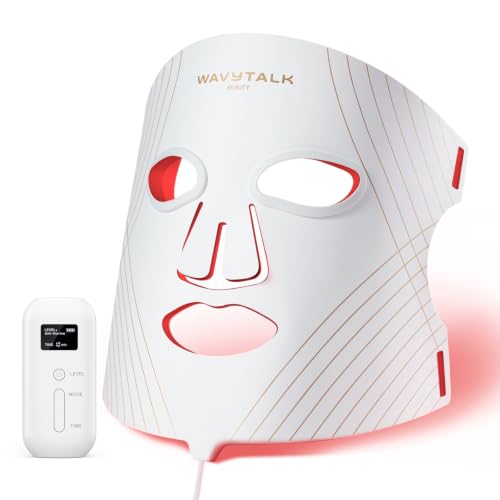
Wavytalk publishes 456 LED chips and a 40mW/cm² power density, which is the second-highest output figure of the two picks that give you one. The layout is three named routines: Anti-Fine Line at 630nm plus 850nm, Anti-Acne at 415nm plus 630nm, and Rejuvenation at 590nm. Three buttons, no dial through seven colours you will never touch. Session length is 10, 15 or 20 minutes.
The build is liquid silicone with light-sealing eye pads and adjustable straps. Wavytalk recommends three to five sessions a week and cites a 28-day clinical test with an 81.5% reduction in breakouts. Treat that as a listing claim, not a promise for your face. Against the INIA, wavytalk trades power density for chip count and a softer fit. Against the GIHWRRI, it trades wavelength count for a real power figure. The minimal setup is the reason to buy it. If you want to press one button and stop thinking, this is that mask.
Pros:
- Highest chip count in this set at 456
- Published 40mW/cm² power density
- Three named preset modes rather than seven colours
- Silicone body with light-sealing eye pads
- Session presets at 10, 15 and 20 minutes
Cons:
- Premium price position for a three-mode device
- No blue-only channel, only paired with red
- No published weight or dimensions
5. gelpal 7-1 Colors Red Light Therapy For Face — Best budget pick
Gelpal is the entry point: 90 LED beads, seven colour channels, and the lowest price position in this set.

Best for: first-time buyers testing whether LED therapy suits their routine Skip it if: you want a published power density or wavelength figure
Gelpal is the cheapest of the five, and the specification sheet reflects it. Ninety LED beads, seven colour channels named as red, blue, yellow, green, purple, cyan and white, plus an indicator light. The listing calls the sessions 15 minutes and says the beads target 60-plus facial zones. What you do not get is a wavelength figure in nanometres for any of those seven colours, or a power density number in mW/cm².
For pore-focused use, the relevant channels are the red and the blue. You cannot tell from the listing whether the red sits at 630nm or 660nm, and the difference matters for what the light does at the dermis. If you have never used LED therapy and want to find out whether wearing a light-up mask for a quarter of an hour is a routine you will keep, gelpal is the lowest-commitment way to test that. If it becomes a habit, upgrade to a mask with published wavelengths. Against every other pick, gelpal makes the same trade: cheaper hardware, thinner spec sheet.
Pros:
- Cheapest of the five picks
- Cordless and portable
- Seven colour channels claim
- 15-minute session length
- 90 LED beads across the mask body
Cons:
- No published wavelength figures in nanometres
- No published power density
- No published weight or dimensions
- Slow seller in this set
Wavelengths, LED counts and power density compared
Three specifications separate a serious LED face mask from a novelty. Here is how the five picks compare on the numbers each listing publishes.
LED count. Wavytalk leads at 456 chips. INIA lists 220. Gelpal lists 90. GIHWRRI lists 70. Shark does not publish a figure. Higher chip counts mean more even coverage across the face, which matters if you have visibly large pores across the T-zone rather than in one spot.
Wavelengths in nanometres. INIA gives you 620nm, 630nm and 850nm plus a blue channel. Wavytalk gives you 415nm, 590nm, 630nm and 850nm. GIHWRRI, Shark and gelpal name colours but do not publish nanometre figures for every channel. For pore-focused skin, 630nm and 850nm are the two you want.
Power density. INIA claims 105mW/cm². Wavytalk claims 40mW/cm². The other three publish nothing. That is the widest gap in this entire comparison, and it is the one specification that separates devices that likely reach the dermis from devices that likely do not.
Does an LED face mask really shrink large pores?
An LED face mask does not physically shrink a pore. Pore size is largely genetic. What red and near-infrared light are claimed to influence is the collagen and firmness of the skin around the pore, which changes how large it looks. Blue light targets the bacteria involved in the breakouts that stretch pores over time. Read every listing in this best LED face mask for large pores comparison as an appearance-focused device, not a resizing tool.
What the listings do not tell you about session time
Session length looks straightforward. Wavytalk offers 10, 15 or 20 minutes. Shark's Better Aging routine is six minutes. Gelpal is 15 minutes. What none of the listings tell you is what the total weekly commitment looks like in practice.
Consider the arithmetic. Wavytalk recommends three to five sessions a week at 10 to 20 minutes. At the high end that is 100 minutes a week, or roughly an hour and forty minutes of sitting still with a mask on your face. INIA does not publish a recommended cadence. GIHWRRI says results are visible in four weeks, without naming a weekly frequency. Shark's four routines each carry their own timing, none of which the listing sums into a weekly total.
Two questions to answer before you buy:
- Do you have 20 uninterrupted minutes on the days you plan to use it?
- Can you sit still, or do you need a mask that stays put while you move?
If the answer to the second is that you move around, a rigid-shell mask like INIA is harder to use than a silicone mask like GIHWRRI or wavytalk. That fit difference matters more than any wavelength debate, because a mask you skip does nothing at any power density.
Who should skip an LED mask entirely?
An LED face mask is a slow-working appearance device. Skip the category if any of these apply:
- You expect a visible pore change in one or two sessions rather than weeks.
- You are on prescription photosensitising skincare and have not cleared the device with your prescriber.
- You will not commit to three or more sessions a week for at least a month.
- You want a treatment that physically extracts or resurfaces, not one that adds light.
- Your primary concern is deep scarring rather than surface appearance.
For any of these, the money is better spent on a professional consultation than on any best LED face mask for large pores in this comparison. The devices here are for shoppers who will run a routine and wait.
The verdict
The INIA Red Light Therapy Mask is the best LED face mask for large pores in this set. It is the only pick that pairs both 630nm red and 850nm near-infrared with a published 105mW/cm² output figure and 220 LED chips, and it does so from a mid-price position rather than the premium end.
Two conditions flip the pick. If a soft silicone fit matters more than raw output, the GIHWRRI FDA-Cleared LED Light Therapy Mask is the better buy: you lose the power density figure and settle for 70 LEDs, but you gain a flexible body with published dimensions and an FDA-cleared listing claim. If you want under-eye cooling built into the same device, the Shark CryoGlow is the only pick in this comparison that offers it, along with four preset treatments and a 2025 release date. The cutoff between INIA and GIHWRRI is whether you will actually sit still for the session. The cutoff between INIA and Shark is whether under-eye appearance sits alongside pores on your list. Wavytalk and gelpal remain useful edges of the set: one for minimal-setup buyers who want the highest chip count, the other for anyone testing whether LED therapy suits their routine at all.
FAQ
What is the best LED face mask for large pores in this comparison?
The best LED face mask for large pores in this comparison is the INIA Red Light Therapy Mask. It is the only pick that publishes both a 105mW/cm² power density and the two wavelengths, 630nm and 850nm, that matter most for the collagen and firmness work that makes pores look tighter. It sits at a mid-price position rather than the premium end.
Is an LED face mask worth it for pore-focused skin?
An LED face mask is worth it for pore-focused skin only if you commit to the routine. Every listing here frames results across weeks, not sessions: wavytalk cites 28 days, GIHWRRI says four weeks. If you will run three to five sessions a week for a month, the picks with published wavelengths and power figures earn their price. If you will not, skip the category.
How does the INIA mask compare with the GIHWRRI mask?
The INIA mask compares with the GIHWRRI mask on a clear trade. INIA gives you the higher LED count at 220 chips, a published 105mW/cm² power density, and dual red and near-infrared channels, but the body is a rigid shell. GIHWRRI gives you 70 LEDs, no power density figure, and an FDA-cleared claim, but the silicone body has published dimensions and contours to the face.
What wavelength matters most for large pores?
The wavelengths that matter most for large pores are 630nm red and 850nm near-infrared. Manufacturers link both to collagen support, and firmer skin around a pore is what makes the opening look smaller. Blue light at 415nm targets the bacteria involved in the breakouts that stretch pores. Colour names alone are not enough: check for the nanometre figures on the listing before you buy.
What is the most common mistake buyers make with LED face masks?
The most common mistake buyers make with LED face masks is comparing colour counts instead of wavelengths and power density. Seven colours on a listing tells you nothing about whether the red channel sits at 630nm or the blue at 415nm, and it tells you nothing about how much of that light reaches the dermis. Two figures decide it: nanometres and mW/cm².
Ready to buy? Start with the INIA mask if you want the highest published output for pore-focused skin and can sit still for a session, and pivot to the GIHWRRI silicone body if fit is the reason your last mask sat unused in a drawer. Whichever you pick, put the mask next to whatever you already do at the same time of day, so the routine anchors to a habit you already keep. That single behavioural choice, more than any spec sheet difference, is what turns a device with 105mW/cm² and 220 LED chips into visibly firmer skin four weeks from now.