Best Earplugs to Block Out Loud Snoring by NRR

A snorer next to you is a low-frequency problem, not a loud one. Here are six earplugs ranked by seal, size range and how many nights each pair actually lasts.

By Tanner TorresUpdated 16 min read
On this page
- Best earplugs to block out loud snoring at a glance
- How I screened the field down to six
- 1. TOAPEX S9 Silicone Earplugs — Best overall
- 2. Moldex Softies Foam Earplugs, 20 Pair — Most versatile
- 3. Mack's Maximum Protection Foam Earplugs — Best for quiet operation
- 4. CURVD Everyday Silicone Earplugs — Best upgrade
- 5. Yoauoop Ultra Soft Foam Earplugs, 10 count — Best budget pick
- 6. Mack's Blackout Foam Earplugs, 7 Pair — Best minimal setup
- Foam or silicone: which seals a snorer out?
- How many nights does a pair actually last?
- What the listings do not tell you about NRR
- Which of these two should you buy?
- The verdict
- FAQ
The best earplugs to block out loud snoring are the TOAPEX S9, a reusable silicone plug that ships with seven eartip sizes and a claimed 50 dB reduction, because a good seal beats a good NRR figure and seven sizes gets you one. If you would rather toss a fresh pair every night, Moldex Softies in 20 pairs at a 33 dB NRR is the smarter buy.
A snorer next to you is a low-frequency problem, and picking the wrong plug means you still hear the rumble even when the room feels quiet. Foam blocks broadband noise well but shifts around when you turn over. Silicone holds its shape but only if the tip actually fits.
Best earplugs to block out loud snoring at a glance
| Pick | Rating | Reusable? | Price |
|---|---|---|---|
Best overall TOAPEX S9 Silicone |
50 dB claim 7 eartip sizes |
Yes, silicone | Check Price |
Most versatile Moldex Softies 20 Pair |
33 dB NRR 20 pairs |
No, disposable foam | Check Price |
Best for quiet operation Mack's Maximum Protection |
33 dB NRR 80 count |
No, disposable foam | Check Price |
Best upgrade CURVD Everyday |
28 dB SNR 5 eartip sizes |
Yes, silicone | Check Price |
Best budget pick Yoauoop Ultra Soft 10 pk |
36 dB claim 10 count |
No, disposable foam | Check Price |
Best minimal setup Mack's Blackout 7 Pair |
32 dB NRR 7 pairs + case |
No, disposable foam | Check Price |



How I screened the field down to six
Six earplugs came out of the wider category on three criteria, weighted in this order.
- A published noise-reduction figure, either an NRR in decibels or an SNR, so the picks can be compared against each other without guessing.
- A clear position in the format split, foam or silicone, since those are the two families a snoring problem actually forces you to choose between.
- A stated size or count, so you know what a pack contains before you buy it.
The order matters because a snoring partner is a nightly problem, not a one-off. A plug with no rated figure sits on a shelf next to plugs that publish one, and it loses. A plug with a rating but a single eartip size loses to a plug with a range, because a seal that leaks at 2 a.m. is a plug that does not work.
Six survived. Two are reusable silicone with multiple eartips, the TOAPEX S9 and CURVD Everyday. Four are disposable foam at 32 to 36 dB, from Moldex, Mack's twice, and Yoauoop. The best earplugs to block out loud snoring in each format sit in this six.
1. TOAPEX S9 Silicone Earplugs — Best overall
Reusable silicone with seven eartip sizes and a claimed 50 dB reduction, which makes it the most flexible fit in the set.
Best for: side sleepers next to a heavy snorer who want to reuse the same pair for months Skip it if: you prefer to throw out a fresh pair every night and never wash anything
Two things separate the S9 from the other reusable pick here. TOAPEX says the design layers a single-layer and a double-layer eartip, and the listing puts the reduction at up to 50 dB. That is a manufacturer claim, not an NRR test, so treat the number as the ceiling rather than the average. The bigger deal is the seven pairs of eartips. CURVD ships five sizes; every foam pick in this roundup ships one. Snoring is a bass-heavy noise, and bass slips through any gap between the tip and your ear canal, so a wider size range is the best earplugs to block out loud snoring have going for them.
Weight is listed at 13.6 g and the carrying case measures 0.66 x 1.65 x 1.65 in, which is smaller than a lip balm. TOAPEX publishes a 5-year warranty, the only warranty stated in this set. Released in 2025, model S9.
The trade-off is the price position, the most expensive pick here, and the fact that reusable silicone needs a rinse every few days.
Pros:
- Seven eartip pairs, the widest size range in the set
- Reusable silicone, no weekly restocking
- 5-year warranty, the only one stated here
- Compact case under two inches on a side
- 50 dB reduction claim from a dual-layer design
Cons:
- The 50 dB figure is a manufacturer claim, not a lab NRR
- Only one seller lists it
- The highest price position in this roundup
- Silicone needs cleaning, foam does not
2. Moldex Softies Foam Earplugs, 20 Pair — Most versatile
A 20-pair bag of 33 dB NRR foam at a mid-range price position, the best all-round foam pick in the set for people who like a fresh pair nightly.
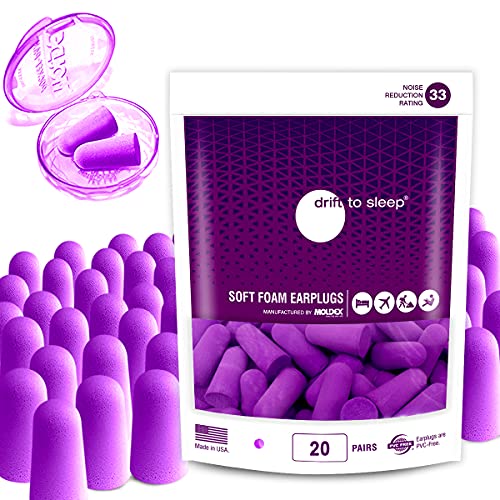
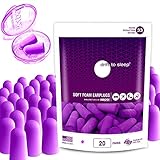
Best for: a household that wants one bag of plugs for sleep, travel and the occasional loud gig Skip it if: you dislike bright colours or want something reusable
Moldex publishes a 33 dB NRR on Softies, tied with the Mack's Maximum Protection for the highest rated figure in this roundup. Two decibels above Mack's Blackout, three above CURVD's 28 dB SNR figure. NRR is not a linear scale, but if you are picking a foam earplug specifically because the person next to you is loud, 33 dB is where you want to be. The pack is 20 pairs, which puts it between the 7-pair Blackout case and the 40-pair Maximum Protection tub.
The listing calls out Comfy Cush foam, low-pressure, slow-release. The dimensions of the packaging, 1.1 x 9.65 x 4.12 in, mean the bag lies flat in a drawer. Model BD11468, sold under the DRIFT TO SLEEP brand.
The trade-off against the Mack's Maximum Protection is capacity for the same rated NRR: Softies gets you 20 pairs, Mack's gets you 40. Against the S9, the trade-off is that you replace foam and you keep silicone.
Pros:
- 33 dB NRR, tied for the highest rating in this set
- 20 pairs, enough for roughly three weeks nightly
- Low-pressure slow-release foam
- Sold under the DRIFT TO SLEEP brand for sleep specifically
- Several sellers stock it
Cons:
- Half the count of the Mack's Maximum Protection tub for a similar rating
- Disposable, so the count is what you get
- Purple is not subtle
- One size, no eartip choice
3. Mack's Maximum Protection Foam Earplugs — Best for quiet operation
Forty pairs of 33 dB NRR foam shaped for larger ear canals, the pick when smaller foam plugs keep falling out mid-snore.
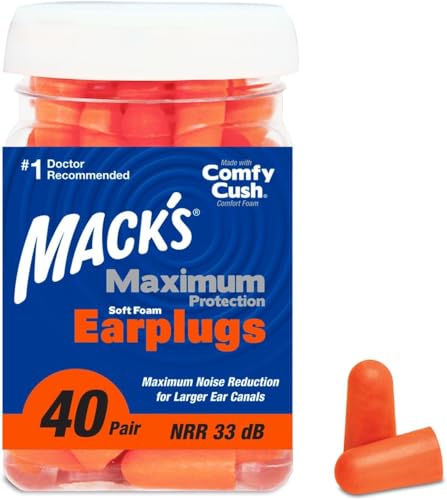
Best for: larger ear canals that swallow smaller foam plugs and let the snoring back in Skip it if: your ear canals run narrow, since these are shaped for the opposite problem
Mack's calls out something the other foam picks in this set do not, and it is the reason this earplug earns a spot rather than doubling up with Softies. The listing says these are a 33 dB NRR foam plug designed for larger ear canals, a common failure point when a plug that should seal simply does not. Two things happen with a plug too small for the canal: it sits shallow, and it works loose when you turn onto your side. Both let a snoring partner right back in.
Beyond the sizing, the specs read like a bulk foam plug. Size listed as 80 Count (Pack of 1), model 9940, orange for visibility on the nightstand. Comfy Cush foam again. Packaging dimensions 4.25 x 2.63 x 2.63 in mean a rigid tub rather than a bag, which is a small win for storage but not a decisive one.
The trade-off is exactly the same problem in reverse: if your ear canals run narrow, this is not the pick, and the CURVD or the S9 with graded eartip sizes will seal better.
Pros:
- 33 dB NRR, tied for the highest rating here
- 40 pairs, roughly six weeks nightly
- Shaped for larger ear canals, which most foam plugs are not
- Rigid tub keeps them clean
- Sells at a mid-range price position
Cons:
- Wrong shape if your ear canals run narrow
- Disposable, no reuse
- Orange, visible on the nightstand
- One size, and it is on the bigger side
4. CURVD Everyday Silicone Earplugs — Best upgrade
A low-profile reusable silicone plug with five eartip sizes and a keychain case, the pick for smaller ears and side sleeping.

Best for: side sleepers with smaller ears who want a low-profile reusable plug on a clip Skip it if: you need the biggest possible NRR figure on paper
CURVD rates the Everyday at 28 dB SNR. That is the lowest published figure in this set, and it is the one number that would put a shopper off if they stopped reading there. Do not stop reading there. CURVD ships five eartip sizes from XXS to L, which is the second-widest range here after the S9. For anyone with smaller ear canals, a 28 dB plug that actually seals is quieter than a 33 dB plug that does not.
The low-profile design is the other reason this is on the list. Side sleepers press an ear into the pillow, and a plug that stands proud gets pushed out of place. CURVD contours to the ear rather than sticking out of it. The case is aluminium, sits on a clip, and attaches to a keyring. The listing dimensions of 4.35 x 3 x 0.7 in describe the packaging rather than the plug itself. Materials are silicone with a satin nickel alloy clip, hypoallergenic per the listing.
The trade-off is the published rating and the price position, second-highest here.
Pros:
- Five eartip sizes from XXS to L
- Low-profile design suits side sleeping
- Reusable silicone, no weekly restock
- Aluminium keychain case
- Hypoallergenic materials per the listing
Cons:
- 28 dB SNR, the lowest published figure in the set
- Only one seller lists it
- Second-highest price position here
- Ships as a single pair, so a lost plug means a full replacement
5. Yoauoop Ultra Soft Foam Earplugs, 10 count — Best budget pick
A cheap ten-count foam pack at a 36 dB claimed reduction, the pick for trying foam plugs before committing to a bigger box.

Best for: trying foam plugs for the first time without committing to a big box Skip it if: you go through more than a pair a week and would rather buy in bulk
The Yoauoop pack is the cheapest of the six and it sells the slowest of the six, so this is a first-time buyer's plug more than a household staple. The listing states a 36 dB reduction, higher than the two 33 dB NRR figures elsewhere in this set, but the phrasing is a manufacturer claim rather than a tested NRR. Foam earplugs sold through Amazon publish NRR under a standardised US test method, and a plug not published under that method is not directly comparable.
That said, the format is the ordinary green slow-rebound foam every foam buyer has met before. Yoauoop calls out a 60-second expansion time and a triple-layer construction. Count is 10, size listed as One Size, colour green. There is no stated weight and no published dimensions.
The trade-off is the count. Ten plugs at a pair a night is five nights. That is a trial, not a supply. If the seal works for you, buy something in bulk after.
Pros:
- Cheapest of the six
- Manufacturer 36 dB claim, higher than the rated foams here
- Familiar slow-rebound foam
- Ten plugs is enough to test a fit
Cons:
- 36 dB is a claim, not a lab NRR
- 10 count is a short supply
- Slowest seller of the six
- Fewer published specifications than the rest
6. Mack's Blackout Foam Earplugs, 7 Pair — Best minimal setup
Seven pairs of 32 dB NRR black foam in an aluminium travel case, the pick when the case matters as much as the plugs.

Best for: a travel kit where the aluminium case matters as much as the plugs Skip it if: you want a big supply at home rather than a small carry pack
Blackout is the odd one out in the foam group. Mack's rates it at 32 dB NRR, one below the Softies and Maximum Protection at 33 dB. That is not a meaningful gap. What is meaningful is the packaging. Seven pairs ship in an aluminium keychain case, weight 15 g, package dimensions 0.75 x 5.25 x 3.38 in. That case is what you are paying for. It clips to a bag or a keyring, keeps the pairs clean between uses, and turns a foam plug into something you actually carry. Model listed as Item # 987.
Fully skinned tapered foam per the listing, which is the standard hygiene story for a plug you want to reuse for two or three nights before binning it. Black rather than the usual bright colours, if that matters at the bedside.
The trade-off is capacity. Seven pairs at a pair a night is a week. This is a travel pack or a top-up, not a household supply, and priced at the second entry-tier position in this roundup it sits close to the Yoauoop.
Pros:
- Aluminium keychain travel case
- 32 dB NRR, close to the highest here
- Fully skinned tapered foam
- Black rather than bright orange or purple
- Several sellers stock it
Cons:
- Seven pairs is one week of nightly use
- One dB below the 33 dB picks
- Entry-tier price, but for fewer plugs
- Disposable, no reuse claimed
Foam or silicone: which seals a snorer out?
Foam and silicone solve the same problem in opposite ways, and the best earplugs to block out loud snoring for you is whichever format you will actually put in every night.
Foam works by expansion. You roll the plug down, push it in, and slow-rebound foam presses outward against the ear canal. That expansion is what gives foam its high NRR figures. Softies and Maximum Protection publish 33 dB NRR, Blackout 32 dB, Yoauoop claims 36 dB. Foam wins on paper, and for a stationary sleeper it wins in practice too.
Silicone works by shape. The eartip is sized to match the canal, and the seal is the fit rather than the pressure. The TOAPEX S9 ships seven eartip sizes; CURVD ships five. Silicone loses on the rated figure, 28 dB SNR for CURVD, but it keeps its seal when you turn over because there is nothing to compress or shift. For side sleepers, that stability matters more than the extra decibels the box quotes.
The cutoff is the sleeping position. If you sleep on your back most of the night, foam is the cheaper and higher-rated answer. If you side sleep, silicone with graded eartip sizes will do a better job of the actual snoring blocking.
How many nights does a pair actually last?
A pair-per-night habit is the default with foam, and it makes the count on the box the thing that matters second-most after the NRR figure. Here is what each pick buys you.
- Mack's Maximum Protection: 40 pairs, roughly 40 nights.
- Moldex Softies: 20 pairs, roughly three weeks.
- Yoauoop: 10 count, so five pairs, roughly five nights.
- Mack's Blackout: 7 pairs, roughly a week.
- CURVD Everyday: 1 pair, reusable for months.
- TOAPEX S9: 1 pair, reusable for months, with a 5-year warranty stated.
The reusable silicone picks change the maths entirely. One pair replaces a running foam supply, and the S9 is the only one with a stated warranty behind it. For a person who deals with a snoring partner every night rather than on a work trip once a quarter, silicone is the cheaper answer over a year even at a higher upfront price position.
What the listings do not tell you about NRR
The NRR figure on a foam earplug is a US laboratory test result under standardised conditions, and the SNR figure is its European equivalent. The listings publish the number. They do not publish two things that matter more for a snoring problem.
The first is the frequency curve. Snoring sits mostly in the low-frequency range, and NRR is a single number that averages across the whole audible spectrum. A plug rated 33 dB might attenuate high frequencies at 40 dB and low frequencies at 20 dB. The listings do not break that down, so a snoring shopper cannot read the box and know which foam has the flatter curve.
The second is the fit derate. NRR is measured with a laboratory fit. In practice, people push plugs in shallow, and real-world attenuation drops several decibels below the rated figure. That is why size range beats rated decibels for a snoring problem: a plug that fits properly loses less to the derate.
Neither point turns up on the Amazon listing. Take the numbers as a rank order between plugs, not as a guarantee of how many decibels of a snoring partner you actually lose.
Which of these two should you buy?
Two picks do the real work: the TOAPEX S9 and the Moldex Softies. Everything else is a variation on one of those two.
The S9 is the answer if you want one pair to last, seven eartip sizes to find a seal, a 5-year warranty, and a manufacturer 50 dB reduction claim behind the dual-layer design. Reusable silicone, low profile, small case. The catch is the price position, the most expensive pick here, and a claimed figure rather than a lab NRR.
The Softies is the answer if you want a rated 33 dB NRR, a familiar foam feel, and 20 pairs to work through before you buy more. Disposable, one size, mid-range price position. The catch is capacity: Mack's Maximum Protection publishes the same 33 dB NRR with 40 pairs, so if you like the format, Mack's stretches further before you reorder.
Pick the S9 if reusable silicone appeals; pick the Softies if disposable foam does.
The verdict
The TOAPEX S9 is the pick for blocking loud snoring, and the deciding factor is the seven eartip sizes rather than the 50 dB claim. Snoring is a bass-heavy noise that slips through any gap in the seal, and no other plug in this set gives you seven ways to close that gap. The 5-year warranty is the only one stated here, and it is the answer to the reasonable objection that a reusable plug feels riskier than a disposable one.
The cutoff between the two tracks is sleeping position and habit. If you side sleep or you would rather rinse a pair every few days than replace a bag every three weeks, take the S9. If you sleep on your back, prefer a fresh pair every night, and want a rated 33 dB NRR figure on the box rather than a manufacturer claim, take the Moldex Softies for 20 pairs at a mid-range price position, or Mack's Maximum Protection for 40 pairs of the same rated foam.
The CURVD is the pick if your ears run smaller than the S9's smallest tip. The Blackout is the pick if you carry plugs in a bag. Everything else is a compromise between those four.
FAQ
Are the best earplugs to block out loud snoring foam or silicone?
The best earplugs to block out loud snoring are silicone if you side sleep and foam if you sleep on your back. Silicone plugs like the TOAPEX S9 and CURVD hold their shape when you turn over, but they publish lower rated figures. Foam plugs like the Moldex Softies and Mack's Maximum Protection publish 33 dB NRR, but the plug can shift when a side sleeper moves.
Is a reusable silicone earplug worth it over foam?
A reusable silicone earplug is worth it when a snoring partner is a nightly problem rather than an occasional one. The TOAPEX S9 ships one pair with a 5-year warranty and seven eartip sizes; a foam habit runs through 30 to 40 pairs a month. Over a year, silicone is cheaper and the size range gives you a better fit. Foam wins for travel and for once-in-a-while use.
What NRR do I need to block loud snoring?
The NRR you need to block loud snoring is as high as you can get while keeping a proper seal, and among the foam picks here that means 33 dB, published on both the Moldex Softies and Mack's Maximum Protection. Silicone plugs like CURVD publish 28 dB SNR. NRR is a lab figure measured with a perfect fit, so a smaller plug that seals will out-perform a larger plug that does not.
TOAPEX S9 or Moldex Softies for a heavy snorer?
TOAPEX S9 or Moldex Softies both handle a heavy snorer, and the choice comes down to whether you would rather rinse a silicone pair or bin a foam one. The S9 wins on size range, seven eartips against one, and on stated warranty. Softies wins on rated figure, 33 dB NRR against a 50 dB claim, and on price position. Side sleepers should take the S9.
What is the pitfall buyers of earplugs for snoring hit most?
The pitfall buyers of earplugs for snoring hit most is picking on the rated NRR figure alone and ignoring size. A 33 dB foam plug that sits shallow in the canal loses several decibels to the fit derate, and a snoring partner comes back through the gap. Plugs with graded eartip sizes, like the TOAPEX S9 with seven and CURVD with five, seal more reliably than a single-size foam.
Start with your sleeping position, since that is the one thing a spec sheet cannot tell you. Side sleepers should order the TOAPEX S9 first and try the smallest three eartips before moving up. Back sleepers should order the Moldex Softies for 20 pairs and see whether a rated 33 dB NRR is enough before scaling up to Mack's Maximum Protection at 40 pairs. The one thing that will not work is picking on the NRR figure alone, ignoring the fit, and hoping. Snoring gets through the gap, not through the plug.