Best Foam Earplugs for Snoring: Mack's Leads
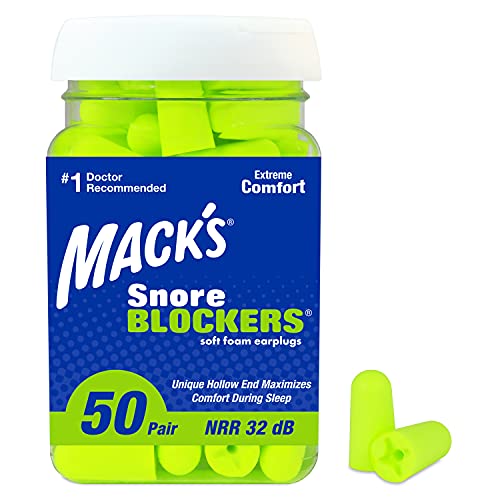
Five foam earplugs ranked for the person lying awake beside a snorer. What the noise ratings really mean, which pack lasts longest, and when the cheaper pick wins.

By Tanner TorresUpdated 13 min read
On this page
- Best foam earplugs for snoring at a glance
- How I screened these five down
- What the noise ratings actually tell you
- 1. Mack's Snore Blockers Soft Foam Earplugs — Best overall
- 2. Mack's Ultra Soft Foam Earplugs — Best upgrade
- 3. Flents Protechs Quiet Time Foam Ear Plugs — Best budget pick
- 4. LYSIAN Foam Ear Plugs for Sleep — Best minimal setup
- 5. Flents Protechs Quiet Contour Foam Ear Plugs — Best for pros
- Can any earplug fully block snoring?
- How many nights does each pack last?
- How to seal a foam earplug properly
- The verdict
- FAQ
The best foam earplugs for snoring are Mack's Snore Blockers, a slow-release foam plug rated at a 32dB NRR with a hollow end shaped for side sleepers. If you want the highest published seal in this group instead, Mack's Ultra Soft edge ahead at 33dB NRR. Here's the misconception worth clearing first: shoppers pick by the biggest noise number on the box, but snoring is a low-frequency rumble, and that number is measured against steady broadband sound, not a person breathing through a blocked nose.
Best foam earplugs for snoring at a glance
| Pick | Noise rating | Count | Price |
|---|---|---|---|
Best overall Mack's Snore Blockers |
32dB NRR / 37 SNR | 50 pair | Check Price |
Best upgrade Mack's Ultra Soft |
33dB NRR | 50 pair | Check Price |
Best budget pick Flents Quiet Time |
33dB NRR | 10 pair | Check Price |
Best minimal setup LYSIAN Foam Ear Plugs |
31dB NRR / 38 SNR | 60 pair | Check Price |
Best for pros Flents Quiet Contour |
33dB NRR | 10 pair | Check Price |


How I screened these five down
I lined up the published specifications side by side before ranking anything. No listing here carries review data I can use, so the decision runs on numbers you can check against the live page: noise ratings, count per box, weight, and what the manufacturer says about the shape.
Two things drove the order.
- The seal. A foam plug that doesn't expand snugly leaks the low rumble of snoring straight through. I weighted the stated noise rating and the shape claims most heavily.
- Nights per box. A snorer doesn't stop snoring after a week, so pairs-per-pack decides real cost over a month. I favored the larger counts for the top spots.
What got cut from the top: the two 10-pair Flents boxes. Both post a 33dB NRR, which matches or beats the winner, but a 10-pair box empties fast if you replace foam plugs the way you should. They earn their places lower down for specific buyers rather than as the default.
Every pick here is disposable foam except for one bonus reusable pair in a single kit. That's the trade you accept with foam: cheap, soft, effective, and thrown away often.
What the noise ratings actually tell you
Here's the trick most shoppers miss. The Noise Reduction Rating, or NRR, is a single decibel figure measured in a lab against steady broadband noise. Snoring is not steady and not broadband. It's a low-frequency, on-off sound, and foam earplugs attenuate low frequencies less than high ones.
So a 33dB NRR plug does not cut 33 decibels off your snoring partner in bed. It cuts less, and the exact amount depends on your ear canal and how well the foam expanded.
- NRR is the US figure. In this set: 32dB, 33dB, 33dB, 31dB, 33dB.
- SNR is the European single-number rating, and it usually reads higher. Mack's Snore Blockers claim 37 SNR; LYSIAN claims 38 SNR.
A 1dB or 2dB gap between these plugs is not something you'll notice in bed. Fit swamps it. That's why the best foam earplugs for snoring are the ones you can seat deeply and comfortably night after night, not the ones with the largest printed number. Treat the ratings as a floor, not a promise.
1. Mack's Snore Blockers Soft Foam Earplugs — Best overall
A slow-release foam plug shaped for the person lying on their side next to a snorer.
Best for: side sleepers next to a heavy snorer Skip it if: you want a reusable plug you can rinse
What sets these apart in this group is the design intent. Mack's built them specifically around the snoring problem, and the listing names two features that matter for it. First, the hollow end, which Mack's says maximizes comfort for a side sleeper. Second, low-pressure slow-release foam, so the plug expands gently against your canal rather than pushing back. If you sleep with an ear against the pillow, a plug that presses out is the one you pick out at 3am.
The rating is a 32dB NRR and a 37 SNR, one decibel under the top NRR here but with the highest paired SNR of the bunch except LYSIAN. You get 50 pairs, matching the largest single-count boxes here. The bright yellow-green color is a small thing that pays off: easy to spot on a dark nightstand.
The trade-off against the rest is price position. These sit at the premium end of the group, and one decibel of NRR less than the Ultra Soft. You pay for the shape, not the number.
Pros:
- Hollow end shaped for side sleepers, per Mack's
- 50 pairs, the largest count tier here
- Slow-release low-pressure foam, per the listing
- High-visibility color easy to find in the dark
- Strong 37 SNR paired with the 32dB NRR
Cons:
- Most expensive tier in this set
- 32dB NRR is one below the group's best
- Disposable only, no reusable option
- Only two sellers list it
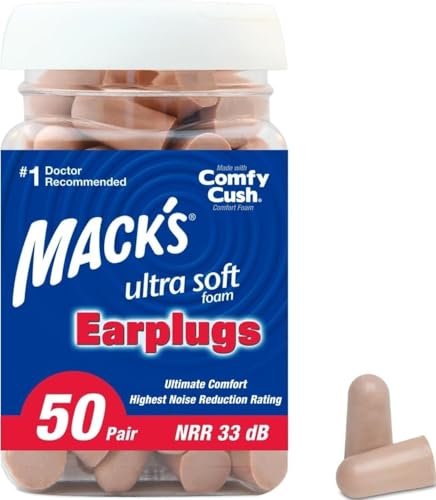
2. Mack's Ultra Soft Foam Earplugs — Best upgrade
The highest published seal in this group, from the plug buyers reach for most often here.
Best for: anyone who wants the highest published seal Skip it if: you need a bright color to find them at night
These carry a 33dB NRR, the joint-highest figure in the set, and of everything here they sell faster than the rest by a wide margin. Mack's calls the material Comfy Cush Comfort Foam and describes it as super low-pressure and slow-release, the same gentle-expansion approach as the Snore Blockers above. At 1.59 oz for the box, they're light, and you get 50 pairs.
So why are they the upgrade and not the winner? They aren't built around snoring specifically. There's no hollow end claim and no side-sleeper language in the listing. For a back sleeper, or anyone who just wants the strongest all-round seal against a rumbling partner, they're the smarter buy and they sit a price tier below the Snore Blockers.
The one real drawback is the beige color. It vanishes on a pale sheet or a wood nightstand, which the bright Snore Blockers solve. Made in the USA, per the listing, if that matters to you.
Pros:
- 33dB NRR, joint-highest here
- Sells fastest of the five in its category
- 50 pairs at a mid price tier
- Low-pressure Comfy Cush foam, per Mack's
- Light 1.59 oz box
Cons:
- No snoring-specific shape or hollow end
- Beige color hard to spot at night
- Disposable only
- Only two sellers list it
3. Flents Protechs Quiet Time Foam Ear Plugs — Best budget pick
The cheapest way to test whether foam plugs work for you before buying a big box.

Best for: trying foam plugs before committing to a big box Skip it if: you burn through pairs every night
This is the cheapest pick of the five and the one to grab if you're not yet sure foam suits your ears. It posts a 33dB NRR, tied for the top rating here, measured under lab conditions per Flents. So you get the group's best printed seal at the lowest entry point. The catch is quantity: 10 pairs, the smallest box in the set alongside the Quiet Contour.
Flents is refreshingly honest in its own copy. The listing states real-world reduction depends on insertion, ear anatomy and activity, and it flags that this plug is not recommended for active sleepers or frequent side sleepers. Read that carefully. If you toss and turn, or sleep on your side against a pillow, the Snore Blockers are the better fit even at a higher price.
For a first purchase, or a travel stash you'll top up rarely, this is a low-risk buy. The purple color helps you spot dropped plugs. The trade-off is plain: you'll reorder often, and per-pair it works out dearer than the 50 and 60-pair boxes over a month.
Pros:
- Cheapest pick in the set
- 33dB NRR, tied for the top here
- Honest fit guidance in the listing
- Purple color easy to locate
Cons:
- Only 10 pairs per box
- Flents flags it against active and side sleepers
- Reorders add up fast for nightly use
- Disposable only
4. LYSIAN Foam Ear Plugs for Sleep — Best minimal setup
One kit that covers nightly disposables, a reusable spare, and a case to carry them.

Best for: keeping one kit for home, travel and reuse Skip it if: you want the smallest possible nightstand footprint
LYSIAN wins on completeness. It's the only pick that bundles more than plain foam: 60 pairs of disposable foam, plus one pair of reusable silicone plugs and a compact carrying case, per the listing. That's the largest disposable count in the group and a genuine two-in-one setup. Foam for home, silicone and case for a trip.
The foam is rated at a 31dB NRR and a 38 SNR, per LYSIAN. That NRR is the lowest of the five, though the gap to the 33dB plugs is small enough that fit matters more. The 38 SNR is the highest here, so under the European measure it reads strongest of all. LYSIAN says the foam expands in 20 to 60 seconds, which is a normal window for slow-release material.
The downside is bulk. At 4.16 oz and 6.3 inches long, the box is the biggest and heaviest in this roundup, driven by the extras. If your nightstand is crowded, that's real. The plugs themselves are fine; it's the kit that takes room.
Pros:
- 60 pairs, the largest count here
- Bonus reusable silicone pair and case
- 38 SNR, the highest in the set
- Skin-friendly non-toxic foam, per LYSIAN
Cons:
- 31dB NRR, the lowest here
- Bulkiest and heaviest box at 4.16 oz
- Premium price tier
- Only two sellers list it
5. Flents Protechs Quiet Contour Foam Ear Plugs — Best for pros
A tapered, latex-free foam plug for someone who splits time between the bedroom and the range.

Best for: latex-sensitive sleepers who split time between bed and range Skip it if: you want the largest count per box
The Quiet Contour is the pick for someone whose needs run past sleep. Flents lists it for sleep, travel, work, concerts, shooting ranges and snoring, and it makes two points the others don't. It's latex-free, which matters if you have a latex sensitivity, and it's tapered to fit the ear canal for all-day wear per the listing. Made in the USA, too.
It carries a 33dB NRR, tied for the top of this group, and sits at the entry price tier, the second-cheapest of the five. So on rating-per-dollar it's strong. Like the Quiet Time above, it comes in a 10-pair box, the smallest count here. That's the ceiling on its rank for a nightly snoring user: you'll reorder often.
The green color helps you find dropped plugs. Against the Snore Blockers, it lacks any snoring-specific hollow end, and against the big boxes it runs out fast. Pick it when the latex-free material or the range-plus-bedroom double duty is what you're actually solving for.
Pros:
- 33dB NRR, tied for the top here
- Latex-free, per Flents
- Tapered shape for all-day wear
- Second-cheapest pick in the set
Cons:
- Only 10 pairs per box
- No snoring-specific shape
- Smallest count for nightly use
- Disposable only
Can any earplug fully block snoring?
No foam earplug fully blocks snoring, and any listing that implies it should be read with care. Snoring is a low-frequency sound, and foam attenuates the low end less than the high end. A well-seated plug at a 32dB or 33dB NRR knocks the rumble down to a soft hum for most people, which is usually enough to fall asleep. It rarely erases it.
Two things decide how close you get:
- Depth of seal. A plug rolled thin and pushed deep, then held while it expands, seals far better than one dropped in loosely.
- Sleep position. Side sleepers compress the outer ear against the pillow, which can break a seal. That's why the Snore Blockers' hollow-end shape earns the top spot.
If plugs alone don't get you there, stack them with a white-noise source. The plugs cut the peak; steady noise masks what's left. That combination is what actually gets light sleepers through the night beside a heavy snorer.
How many nights does each pack last?
Foam plugs are disposable by design. Rolled, inserted and slept in, a pair picks up earwax and grime and loses springiness, so most people swap them every one to three nights. That makes count the quiet cost driver, not the sticker.
Here's the count picture across the set:
- 60 pairs — LYSIAN, the longest-lasting box here
- 50 pairs — Mack's Snore Blockers and Mack's Ultra Soft
- 10 pairs — both Flents boxes
If you replace a pair every two nights, a 50-pair box runs roughly three to four months and a 60-pair box a little longer. A 10-pair box is closer to three weeks. That's the real reason the big boxes lead this ranking for nightly snoring use: the cheapest sticker isn't the cheapest month. Buy the small Flents boxes to test fit, then move to a 50 or 60-pair box once you know foam works for your ears.
How to seal a foam earplug properly
A poorly seated foam plug leaks the exact low rumble you're trying to block, so technique matters more than the rating on the box. Flents spells out the method in its own listing, and it applies to all five picks here.
- Roll it thin. Compress the foam between finger and thumb into a tight, crease-free cylinder.
- Reach over. Pull the top of your ear up and back with the opposite hand to straighten the canal.
- Insert deep. Push the rolled plug well in, not just at the opening.
- Hold and wait. Keep a fingertip on it for up to 30 seconds while the slow-release foam expands to fill the canal.
If you can still hear yourself talk clearly and loudly, the seal isn't there. Redo it. A plug seated properly muffles your own voice noticeably, and that muffling is your sign the low-frequency snore will be dampened too.
The verdict
For most people lying awake next to a snorer, Mack's Snore Blockers are the right default. The hollow end and low-pressure foam are built for the exact problem, they come 50 pairs to a box, and the bright color means you find them in the dark. That combination is what a side sleeper actually needs, and it's why they take the top spot despite sitting at the premium tier.
Spend up, or rather sideways, only when the shape isn't your issue. If you sleep on your back and just want the strongest published seal, Mack's Ultra Soft match the highest 33dB NRR here at a lower price tier, and they're the plug buyers reach for most often in this category.
Spend the least when you're testing the waters. Flents Quiet Time gives you a tied-top 33dB NRR at the lowest entry point, though only 10 pairs. The cutoff is simple: below a nightly habit, buy small and cheap to find your fit; above it, buy a 50 or 60-pair box and stop reordering every three weeks.
FAQ
Are foam earplugs worth it for snoring?
Foam earplugs are worth it for snoring if you accept they muffle rather than erase the sound. A well-sealed pair at a 32dB or 33dB NRR drops a partner's rumble to a soft hum for most people, which is usually enough to fall asleep. They're inexpensive per pair and easy to try, so the downside risk is small.
Is it worth paying more for the Mack's Snore Blockers?
Paying more for the Mack's Snore Blockers is worth it if you sleep on your side. The listing's hollow end is shaped to reduce pressure against a pillow-pressed ear, which is exactly where a standard plug fails. If you sleep on your back, the cheaper Mack's Ultra Soft match a higher 33dB NRR and save you money.
What does the NRR number on foam earplugs mean?
The NRR number on foam earplugs is the Noise Reduction Rating, a lab figure in decibels measured against steady broadband noise. It's not the real-world drop you'll get, since snoring is low-frequency and fit varies. In this group the ratings run from 31dB to 33dB, a gap small enough that a proper seal matters far more.
Mack's Snore Blockers or Mack's Ultra Soft for snoring?
Mack's Snore Blockers or Mack's Ultra Soft comes down to sleep position. The Snore Blockers add a hollow end for side sleepers and a 37 SNR, at the premium tier. The Ultra Soft carry a slightly higher 33dB NRR at a mid price and are the fastest seller here. Side sleepers, Snore Blockers; back sleepers, Ultra Soft.
What is the best foam earplugs for snoring mistake buyers make?
The best foam earplugs for snoring mistake buyers make is picking by the biggest decibel number and inserting the plug loosely. A 1dB rating gap is invisible in bed, but a shallow seal leaks the whole low rumble through. Roll the foam thin, push it deep, and hold it 30 seconds while it expands.
Start by matching the pick to how you sleep, not to the largest number on the box. If you turn onto your side against a pillow, the Snore Blockers' hollow end is the feature that decides it, and 50 pairs carries you through months of nights. Roll each plug thin, seat it deep, and give it half a minute to expand. Do that, pair it with a little white noise if the snoring is loud, and a foam plug that costs almost nothing turns a rumbling bedroom into something you can sleep through.