Best Panel Red Light Therapy Device for Home Use

Six panels compared on wavelength pairing, LED count, and coverage, with a clear winner and the conditions that flip the pick to the runners-up.

By Tanner TorresUpdated 15 min read
On this page
- What actually decides a red light panel
- Best panel red light therapy device at a glance
- How I ranked these six panels
- 1. Viconor Red Light Therapy for Face and Body — Best overall
- 2. Viconor Red Light Therapy for Face and Body — Best budget pick
- 3. INTEO Red Light Therapy for Face and Body — Best upgrade
- 4. Hooga Red Light Therapy Panel Device HG200 — Most versatile
- 5. BestQool Red Light Therapy Panel — Best for families
- 6. Hooga Red Light Therapy Panel Device PRO300 — Best premium
- Does a bigger panel really win?
- How close should you sit?
- What the listings leave out
- The verdict
- FAQ
The best panel red light therapy device is the Viconor Red Light Therapy for Face and Body, a 120-LED panel that pairs one 660nm red diode with two 850nm infrared diodes per light. If you need to cover your whole body in one sitting, the Hooga PRO300 with its 61.2-inch panel body is the better buy. Here is what most buyers get wrong: they chase the biggest panel and ignore how the two wavelengths are paired. That pairing is what a bad pick fails at, and it decides everything below.
What actually decides a red light panel
Most guides compare LED count and stop there. That is not what decides it. The wavelength pairing is.
Every panel here emits two wavelengths: 660nm red, which stays near the skin surface, and 850nm near-infrared, which the listings say reaches deeper. What changes between panels is how those two are arranged. The Viconor packs three diodes per light, one red and two infrared. The Hooga panels use a 1:1 ratio, one of each in a dual-chip LED. INTEO says each light carries two chips.
That ratio changes the treatment. A 1:1 split gives even weight to surface and deep work. A red-light-first arrangement leans toward skin. Neither is wrong, but they suit different goals.
Here is the part buyers miss. A big panel with a weak pairing does less than a small panel aimed well. LED count tells you coverage area, not what reaches your skin. So read the wavelengths first, the count second.
The best panel red light therapy device for you depends on which area you treat most. Face and small zones reward a focused panel. Whole-body sessions reward a tall one.
Best panel red light therapy device at a glance
| Pick | Wavelengths | LEDs / Panel | Price |
|---|---|---|---|
Best overall Viconor Red Light Therapy for Face and Body |
660nm + 850nm 1 red : 2 IR |
120 LED | Check Price |
Best budget pick Viconor Red Light Therapy for Face and Body |
660nm + 850nm 1 red : 2 IR |
120 LEDs | Check Price |
Best upgrade INTEO Red Light Therapy for Face and Body |
660nm + 850nm 2-chip lights |
46.5 in tall | Check Price |
Most versatile Hooga Red Light Therapy Panel Device HG200 |
660nm + 850nm 1:1 ratio |
40 LEDs | Check Price |
Best for families BestQool Red Light Therapy Panel |
660nm + 850nm dual-chip |
13.1 x 8.4 in | Check Price |
Best premium Hooga Red Light Therapy Panel Device PRO300 |
660nm + 850nm 60 dual-chip |
61.2 in tall | Check Price |



How I ranked these six panels
I lined up the published specifications side by side and weighted three things, in order.
- Wavelength pairing, weighted heaviest. Every panel here runs 660nm and 850nm, so the split between them broke the ties. A clear, documented ratio scored above a vague one.
- Coverage relative to purpose. LED count and panel size mattered, but only against what the panel is built to treat. A tall body panel and a small face panel are judged on different jobs.
- What the listing actually publishes. A panel with a stated weight, dimensions, and warranty beat one that leaves those fields blank, because you can plan around real numbers.
Those weights follow from the deciding criterion. If the pairing is what matters most, it earns the most points. Coverage comes next because it sets what a single session can reach. Documentation comes last but still counts, since a listing that hides its weight makes you guess at shelf and stand fit.
Two panels here publish a warranty. Only two list a weight in pounds. That gap shaped the lower half of the ranking as much as the specs did.
1. Viconor Red Light Therapy for Face and Body — Best overall
The Viconor wins because 120 LEDs and a three-diode-per-light layout give it the densest published output in this set for face and targeted body work.
Best for: one person treating face and small body areas at home Skip it if: you need full-body coverage in one session
This is the only panel here that spells out its diode math. Viconor says each of the 120 LEDs carries one 660nm red light and two 850nm infrared lights. That leans the panel toward deeper 850nm output while keeping visible red on the surface, which suits face and joint work.
The brand also claims a curved surface that focuses the light, saying it concentrates the source over the face. I read that as a coverage tweak, not a power spec, so treat it as the manufacturer's claim. The panel is listed in black with a 2026 release.
What holds it back is documentation. The listing gives no weight and no warranty, so you are planning stand and shelf fit blind. Against the Hooga PRO300, it also cannot match full-body reach in a single sitting. But for the buyer treating face, neck, and one joint at a time, the dense pairing and the second-cheapest position here make it the default.
Pros:
- Densest LED layout here at 120 LEDs
- Documented 1 red to 2 infrared diode ratio
- Second-cheapest of the six
- Manufacturer claims a light-focusing curved surface
Cons:
- No published weight or dimensions to plan around
- No stated warranty
- Cannot cover the whole body at once
2. Viconor Red Light Therapy for Face and Body — Best budget pick
This second Viconor shares the 120-LED pairing but sits as the cheapest of the six, making it the lowest-risk way to try a panel.

Best for: first-timers who want the lowest entry cost here Skip it if: you want stated weight and dimension figures upfront
The listing repeats the same core claim as the overall winner: 120 LEDs, each with one 660nm red diode and two 850nm infrared diodes. So you get the same wavelength split that ranks the pairing at the top of the set, at the cheapest position here.
It is listed in a brown-black finish with a count of one. The dimensions field reads 0.39 x 0.39 x 0.39 inches, which is a packaging or component figure, not the panel itself, so I would not plan a shelf around it. That kind of gap is the trade-off you accept at this price.
Against the sibling above, the difference is presentation and position rather than a documented spec change. Both share the diode math. If your only worry is spending the least to find out whether red light suits your routine, this is the entry point. If you want a panel that publishes real weight and dimensions, move up the list to the INTEO or a Hooga.
Pros:
- Cheapest of the six
- Same documented 660nm plus 850nm pairing as the winner
- 120-LED count matches the top pick
- Manufacturer claims a focusing curved surface
Cons:
- Listed dimensions look like packaging, not the panel
- No published weight or warranty
- Marketing overlaps heavily with the pricier sibling
3. INTEO Red Light Therapy for Face and Body — Best upgrade
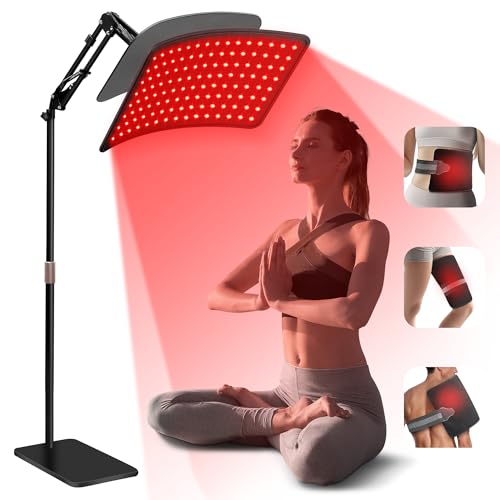
The INTEO earns the upgrade slot because it pairs a 46.5-inch stand with brightness levels, timer options, and pulse modes no other panel here lists.
Best for: buyers who want brightness levels, pulse modes, and a tall stand Skip it if: you want the simplest possible one-button device
This is the most feature-loaded listing in the set. INTEO says the panel offers five brightness levels and nine timer options from 10 to 90 minutes, plus three modes: constant light, 10Hz pulse, and 40Hz pulse. That control range is unique here, so if you like dialling in a session, this is the pick.
The specs back the build. It weighs 7 lb, measures 3.8 x 16.7 x 12 in, and reaches a stated 46.5 in on its stand, which INTEO calls aviation-grade aluminium with 180-degree flipping. The light panel itself is listed at 13 x 7.5 in. It also carries a 2-year warranty, one of only two here.
The detachable design, which INTEO says works with an elastic strap for on-the-go use, is a claim I would verify against the live listing. The trade-off is complexity. More modes mean more to learn, and it costs more than both Viconor panels for output you cannot compare directly, since irradiance is not published.
Pros:
- Five brightness levels and nine timer options
- Constant, 10Hz, and 40Hz pulse modes
- Published 2-year warranty
- Detachable panel with a tall adjustable stand
Cons:
- No published irradiance figure to judge output
- More settings mean a steeper learning curve
- Costs more than both Viconor picks
4. Hooga Red Light Therapy Panel Device HG200 — Most versatile
The HG200 is the most versatile pick because its compact 9.5 x 6 in body fits a desk or nightstand while keeping the clean 1:1 wavelength ratio.

Best for: desk or nightstand use in a tight space Skip it if: you want maximum panel area
This is the smallest panel here at 1 x 9.5 x 6 in, and that is the point. It slots onto a desk, a shelf, or a nightstand where the tall body panels will not fit. Hooga says it uses 40 individual 5W LEDs at a 1:1 red-to-infrared ratio, which keeps the pairing balanced across surface and deep output.
Hooga also claims irradiance over 90mW/cm2 at 6 inches, which is one of the few power figures anyone in this set publishes. Treat it as the brand's claim, but it gives you a distance to plan around. It includes a timer and an adjustable stand.
It sits mid-priced here. The obvious cost is coverage. With 40 LEDs and a small footprint, you treat one area at a time, moving the panel as you go. That makes it slow for full-body routines but ideal for a focused face or shoulder session at a desk. Against the tall INTEO and PRO300, it trades area for portability, and for a small room that trade is worth making.
Pros:
- Smallest footprint at 9.5 x 6 in
- Balanced 1:1 red-to-infrared ratio
- Manufacturer claims over 90mW/cm2 at 6 in
- Built-in timer and adjustable stand
Cons:
- Only 40 LEDs, so coverage is small
- Slow for full-body sessions
- No published weight or warranty
5. BestQool Red Light Therapy Panel — Best for families
BestQool suits a shared household because its 105W panel claims high output in a 13.1 x 8.4 in body that several people can rotate through quickly.

Best for: a household sharing one higher-output panel Skip it if: you want a published warranty
BestQool leans on power. The listing states 105W and claims 95.6 mW/cm2 irradiance at 3 inches, the highest close-range figure quoted in this set. For a family passing one panel around, stronger output means shorter turns, which is the case for the family label.
The panel measures 13.1 x 8.4 x 2.1 in and weighs 4.8 lb, so it moves between rooms easily. Its dual-chip LEDs emit both 660nm and 850nm, and BestQool says you can run red, infrared, or both. A U-shaped stand lets you tilt it on a table or nightstand.
The catch is the missing warranty. It is the most expensive of the two premium-positioned picks after the PRO300, yet its listing publishes no warranty term, while the INTEO and the PRO300 both do. That is a real gap when several people will handle one unit over years. The irradiance figure is measured at 3 inches, a closer distance than Hooga's 6-inch quote, so compare like with like before you decide it is brighter.
Pros:
- Highest claimed close-range irradiance at 95.6 mW/cm2
- Stated 105W output
- Light at 4.8 lb and easy to move
- Independent red, infrared, or combined modes
Cons:
- No published warranty
- Irradiance quoted at a closer 3 in than rivals
- Sits at a premium price for a mid-size panel
6. Hooga Red Light Therapy Panel Device PRO300 — Best premium
The PRO300 is the premium pick because its 61.2-inch panel body and 3-year warranty deliver the only true full-body coverage in this set.

Best for: serious users who want a tall panel and a stated warranty Skip it if: you have a small room or a tight budget
This is the panel for standing sessions. At 3.1 x 61.2 x 15.7 in and 9.48 lb, it is by far the tallest and heaviest here, and that height is what lets it treat your whole body without repositioning. It ships with a vertical stand and, Hooga says, connects to other PRO Series panels for larger setups.
It runs 60 dual-chip LEDs, each carrying both 660nm and 850nm, with a digital timer and independent red and near-infrared controls. It carries a 3-year manufacturer warranty, the longest in this set. One listing line mentions 900 dual-chip LEDs, which conflicts with the 60-LED spec, so verify the exact configuration on the live page before buying.
The cost is footprint and price. This is the most expensive pick here and the largest, so a small room or a tight budget rules it out fast. But for a committed user who wants to stand in front of a full panel and have a warranty behind it, nothing else here competes on coverage.
Pros:
- Tallest panel at 61.2 in for full-body coverage
- Longest warranty here at 3 years
- Digital timer with independent red and infrared controls
- Modular, connects to other PRO Series panels
Cons:
- Most expensive of the six
- Largest and heaviest at 9.48 lb
- Listing LED counts conflict, 60 versus 900
Does a bigger panel really win?
Not on its own. A bigger panel wins only when your goal is coverage, and it loses when your goal is a focused, dense treatment.
Here is the split in this set:
- Small and dense. The Viconor packs 120 LEDs into a face-and-body panel. The Hooga HG200 fits 40 LEDs into a 9.5 x 6 in body. Both aim tight and treat one zone well.
- Tall and wide. The INTEO reaches 46.5 in on its stand. The PRO300 stretches to 61.2 in. Both cover large areas in fewer moves.
Size tells you how much you can hit at once, not how much reaches your skin. A 61.2-inch panel spread thin can deliver less to any one spot than a compact panel held close. So the honest answer is that a bigger panel wins for standing full-body sessions and loses for a quick face treatment at a desk. Match the size to the job, not the other way round.
How close should you sit?
Distance changes the numbers more than most buyers expect, because irradiance drops fast as you move away.
Two panels here publish a figure, and they measure at different distances. BestQool claims 95.6 mW/cm2 at 3 inches. Hooga claims over 90mW/cm2 at 6 inches for the HG200. Those look close, but the Hooga figure holds at twice the distance, so you cannot rank them by the raw number alone.
A short checklist before you compare:
- Find the distance each irradiance figure is measured at.
- Match distances before you call one panel brighter.
- Treat every quoted figure as the manufacturer's claim, not a lab result.
The practical takeaway is simple. Sit at the distance the brand measured, then adjust to what feels comfortable. A panel quoted at 6 inches gives you more room to work than one quoted at 3.
What the listings leave out
The single biggest gap is irradiance. Four of the six panels here publish no power figure at all, so you cannot compare their true output against the two that do. When a listing is silent on power, LED count and panel size are all you have to judge by.
Warranty is the second gap. Only the INTEO with 2 years and the PRO300 with 3 years state a term. The rest leave the field blank, which does not mean there is none, only that you should confirm it before buying.
Weight and dimensions vary too. The two Viconor listings skip usable weight and panel size, while the tall INTEO, BestQool, and PRO300 all publish real numbers. If you are mounting a panel or clearing shelf space, that missing data forces a guess. Check the live listing for anything the spec sheet omits.
The verdict
If you are treating your face, neck, and one joint at a time, the Viconor Red Light Therapy for Face and Body is the best panel red light therapy device here. Its 120 LEDs and documented one-red-to-two-infrared pairing give it the densest, best-explained output in the set, and it sits second-cheapest. That combination is hard to beat for targeted home sessions.
If you want to stand in front of a panel and treat your whole body in one session, the Hooga PRO300 is the pick instead. Its 61.2-inch body is the only one here built for standing full-body coverage, and its 3-year warranty is the longest in this set. The cutoff is your session goal: below full-body, the Viconor's density wins; at full-body, the PRO300's height and warranty win.
Two conditions flip the choice further. On the tightest budget, the second Viconor shares the same pairing for the lowest price here. If you want brightness levels and pulse modes, the INTEO with its five levels and 46.5-inch stand takes it. Match the panel to the job first, the price second.
FAQ
Is a panel red light therapy device worth it over a handheld?
A panel red light therapy device is worth it when you treat larger areas or several zones in one routine. A handheld covers a small spot at a time. Panels here range from the compact Hooga HG200 at 9.5 x 6 in up to the 61.2-inch PRO300, so a panel earns its space if you want to sit or stand for a full session rather than press a small wand.
What wavelengths should the best panel offer?
The best panel offers both 660nm red and 850nm near-infrared, and every pick in this guide does. Red at 660nm stays near the skin surface. Infrared at 850nm reaches deeper, per the listings. What differs is the ratio. The Hooga panels use 1:1, while the Viconor pairs one red diode with two infrared. Choose the split that matches your goal.
How does the Viconor compare to the Hooga PRO300?
The Viconor compares to the Hooga PRO300 as focus against coverage. The Viconor packs 120 LEDs into a face-and-body panel with a documented one-red-to-two-infrared layout, best for targeted zones. The PRO300 stretches to 61.2 in with 60 dual-chip LEDs and a 3-year warranty for full-body standing sessions. Pick the Viconor for your face, the PRO300 for your whole body.
Do any of these panels come with a warranty?
Yes, two of these panels come with a stated warranty. The INTEO lists 2 years and the Hooga PRO300 lists 3 years, the longest here. The Viconor pair, the Hooga HG200, and the BestQool leave the warranty field blank on their listings. A blank field does not confirm there is none, so check the live product page before you rely on coverage.
What is the most common mistake buying a red light panel?
The most common mistake buying a red light panel is chasing LED count while ignoring wavelength pairing and distance. A dense panel held at the wrong distance underdelivers, and a big panel with a weak split does less than a small one aimed well. Read the ratio and the measured distance first. BestQool quotes 3 inches, Hooga quotes 6, so compare like with like.
Start by naming your session goal, because that single answer sorts this whole list. Treating your face and a joint at a time points straight to the Viconor, where the dense 120-LED pairing and second-cheapest position do the most work for the least outlay. Wanting to stand for a full-body session points to the PRO300 and its 61.2-inch panel. The best panel red light therapy device is the one whose size and wavelength split match the job you will actually do most, so pick that job first and let the specs follow.