Best Posture Correctors by Fit Range and Weight

Five upper-back braces compared on the numbers that actually matter: chest fit range, listed weight, strap design and how much of the torso they cover. ComfyBrace leads on published fit range.

By Tanner TorresUpdated 16 min read
On this page
- Best posture corrector for immune support at a glance
- What a posture corrector can and cannot do for immune support
- How I screened these five braces
- What actually decides fit: chest range, not size letters
- 1. ComfyBrace Posture Corrector for Men and Women — Best overall
- 2. BraceTop Upgraded Posture Corrector Back Brace for Men and — Best premium
- 3. Schiara Posture Corrector for Men and Women — Best budget pick
- 4. Posturace Posture Corrector for Women & Men — Most versatile
- 5. sundpik Posture Corrector for Women and Men — Best for families
- How long should you wear a posture corrector each day?
- ComfyBrace vs BraceTop: which one should you buy?
- The verdict
- FAQ
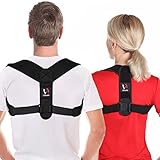
The best posture corrector for immune support hopefuls is the ComfyBrace Posture Corrector, because it publishes the widest usable chest range in this group, 30 to 43 in, at a listed 4.66 oz. If you want lumbar coverage as well as a shoulder pull, the BraceTop Upgraded Posture Corrector is the better buy. Get the fit wrong and you own an expensive drawer ornament: too tight and you unbuckle it within twenty minutes, too loose and the straps slide off your shoulders with the first stretch.
Best posture corrector for immune support at a glance
| Pick | Chest fit range | Listed weight | Price |
|---|---|---|---|
Best overall ComfyBrace Posture Corrector for Men and Women |
30–43 in claim | 4.66 oz | Check Price |
| Size L, straps fully adjustable | Not listed; 3.94 in box | Check Price | |
Best budget pick Schiara Posture Corrector for Men and Women |
30–42 in claim | 4.94 oz | Check Price |
Most versatile Posturace Posture Corrector for Women & Men |
One Size, backpack straps | Not listed | Check Price |
Best for families sundpik Posture Corrector for Women and Men |
Adjustable, no range published | Not listed | Check Price |




What a posture corrector can and cannot do for immune support
Let's deal with the search phrase honestly. None of these five listings claims an immune benefit, and I'm not going to pretend otherwise. What some of them do claim is circulation and breathing. The sundpik listing says opening your shoulders makes "your bones healthier, circulatory system better, breathing more smoothly." That's the manufacturer's wording, not a measured outcome, and it's the closest any of these five gets to the territory the phrase implies.
So treat immune support as a question you answer for yourself, not a specification you can buy. A brace is a mechanical device. It pulls your shoulder blades back. What that does downstream of your ribcage is not something a chest-strap measurement can tell you.
Here's the practical read. If you're shopping the best posture corrector for immune support category because you sit hunched over a laptop for nine hours and something feels compressed, the useful question is whether the brace holds your chest open long enough to matter without you tearing it off in frustration. That comes down to three things:
- Whether the chest range actually covers your measurement
- Whether the strap design lets you adjust without help
- How much of your torso the brace covers
Everything else is packaging. And if you have a medical concern, a brace is not the answer to it.
How I screened these five braces
I started with the published data and nothing else. Every listing in this category makes broadly the same promise: straighter back, less pain, more confidence. That makes the marketing copy useless as a differentiator, so I ignored it as a screening tool and sorted on numbers instead.
Three data points survived the cut:
- Published chest range. Two of the five give one. That's the single most decision-relevant figure in the whole category, and three brands don't print it.
- Listed weight and dimensions. Weight tells you how much material you're strapping on. ComfyBrace lists 4.66 oz, Schiara 4.94 oz. The other three list neither.
- Coverage type. Upper-back-only shoulder pull, or a full-back design with a lumbar belt.
What I cut: anything where the listing gave me a product name and a feature paragraph and nothing measurable. Two of the five picks here are thin on specifications, and I've said so in their sections rather than papering over it.
Sales position mattered as a tiebreaker, not a criterion. ComfyBrace is the one buyers choose most often in this set by a wide margin, which is worth knowing but proves nothing about fit on your body. The Posturace is the slowest seller of the five.
What actually decides fit: chest range, not size letters
Most posture brace guides compare strap width or padding. That's not what decides it. The chest circumference range is.
Look at what happens across this set. ComfyBrace publishes 30 to 43 in. Schiara publishes 30 to 42 in and adds a parenthetical warning to verify before ordering, which tells you the brand fields returns from people who didn't. BraceTop ships in size L with fully adjustable shoulder straps but no printed circumference. Posturace is "One Size." sundpik publishes no size data at all.
That single inch of difference between ComfyBrace and Schiara sounds trivial until your chest measures 42.5 in. Then it's the whole purchase.
Here's the trick with size letters on braces: they're not standardised between brands, so an L from BraceTop and a Medium from Schiara are not comparable numbers. A circumference range is comparable. A letter is a guess dressed as information.
Measure yourself before you buy anything. Tape around the fullest part of your chest, arms down, breathing normally. Write the number down. Then:
- Under 30 in: none of these five publishes a range that low. Look at youth-sized braces.
- 30 to 42 in: all five are candidates, and the two entry picks become genuinely appealing.
- 42 to 43 in: ComfyBrace is the only one with a published range that reaches you.
- Over 43 in: buy the BraceTop in a larger letter size, or look outside this set.
That's the cutoff, and it's why the best posture corrector for immune support shortlist looks different for different bodies.
1. ComfyBrace Posture Corrector for Men and Women — Best overall
The widest published chest range in this set at the lowest listed weight, which is exactly the combination that keeps a brace on your body instead of in a drawer.
Best for: desk workers with a 30 to 43 in chest who want the widest published fit range Skip it if: your chest measures above 43 in
What separates this from the other four is that ComfyBrace tells you who it fits. The listing states an orthopedically created design for chest sizes of 30 in to 43 in, which is one inch more headroom at the top than Schiara and infinitely more information than the three picks that publish nothing.
The weight figure matters more than it looks. At 4.66 oz it's the lightest of the two braces here that list a weight, and the packed dimensions of 0.39 x 6.3 x 4.72 in describe something genuinely flat. That thinness is what determines whether a brace vanishes under a work shirt or announces itself through the fabric.
ComfyBrace also handles the break-in question better than most. The listing recommends starting at 5 to 10 minutes per day and building to an hour or two, which is a sane ramp and reads like a brand that has dealt with people who wore one for six hours on day one and hurt themselves.
It's also the one buyers here pick most often, by a margin of roughly three to one over the next-closest in this set. The trade-off is coverage. This is a shoulder-pull brace, full stop. If your complaint is lower back rather than rounded shoulders, the BraceTop's lumbar belt does something this cannot.
Pros:
- Widest published chest range here, 30 to 43 in
- Lightest listed weight of the set, 4.66 oz
- Flat 0.39 in profile for wear under clothing
- Clear break-in schedule published by the brand
- The one buyers choose most often in this group
Cons:
- Upper back only, no lumbar support at all
- Sits in the more expensive half of this set
- Only one seller lists it
- No published warranty term
2. BraceTop Upgraded Posture Corrector Back Brace for Men and — Best premium
The only pick here that covers your lumbar region as well as your shoulders, which makes it the right choice if your pain is below the shoulder blades.

Best for: anyone who wants lumbar coverage as well as shoulder pull Skip it if: you want something thin enough to disappear under a fitted shirt
This is the structural outlier. Where the other four are shoulder harnesses, BraceTop describes a three-in-one design covering back, chest and shoulder, plus a widened waist belt that the listing says helps avoid waist injury while lifting. That's a different product category wearing the same search term.
The specifications back up the extra bulk. BraceTop lists a high-elastic support strip for stable support and a perforated elastic band for tension and resilience. The full back panel is described as dense mesh cloth. Shipped size is L, with dimensions of 3.94 x 3.94 x 3.94 in, and the straps are stated as fully adjustable, with the brand describing it as unisex and suitable for youth and elderly wearers.
Here's where it costs you. No weight is published, and the 3.94 in cube tells you nothing about how flat it lies. A brace with a wide lumbar belt and a rigid support strip is not going under a tailored shirt, and pretending otherwise sets you up for disappointment. This is the most expensive pick here and the bulkiest by design.
Buy it because you want the lower back covered. Don't buy it expecting to wear it invisibly to a meeting.
Pros:
- Only pick covering upper back and lumbar together
- Widened waist belt for load support
- Dense mesh full-back panel for airflow
- Fully adjustable shoulder straps, sized L
Cons:
- No listed weight, so bulk is hard to judge
- Full lumbar belt is visible under fitted clothing
- Most expensive pick in this set
- No published chest circumference range
3. Schiara Posture Corrector for Men and Women — Best budget pick
The cheapest brace here that still publishes a chest range and a weight, which makes it the sensible way to find out whether you'll actually wear one.
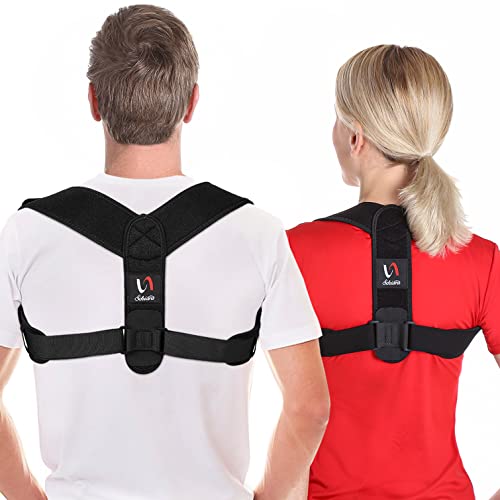
Best for: first-time buyers testing whether a brace helps at all Skip it if: your chest is near or over 42 in
Schiara is the cheapest of the five and it's the only entry-price pick that publishes real numbers. Chest range is stated at 30 in to 42 in for the Medium, with the listing adding "please verify before ordering." Listed weight is 4.94 oz, marginally heavier than the ComfyBrace, and the packed dimensions of 0.21 x 9.84 x 2.76 in make it the flattest thing in this comparison by a clear margin.
That 0.21 in figure is the most interesting number on the page. It's roughly half the ComfyBrace thickness, which supports the brand's claim that the brace is undetectable under clothes. Schiara describes the fabric as lightweight but strong, soft and breathable.
The catch is the 42 in ceiling. Schiara gives you one inch less top-end room than ComfyBrace, and the size on this listing is Medium rather than one-size, meaning the range you see is for that specific size. If you measure 41 in you're near the edge, and near the edge of a brace's range is where straps dig and buckles pinch.
The other trade-off is honest and simple: it does less. No lumbar panel, no support strip, no published break-in schedule. It's a straightforward shoulder pull at the lowest price here, and for a first brace that's a reasonable thing to be.
Pros:
- Cheapest pick in this set
- Publishes chest range, 30 to 42 in
- Flattest profile here at 0.21 in
- Listed weight of 4.94 oz for comparison
Cons:
- Chest range tops out one inch below ComfyBrace
- Medium sizing limits headroom for larger frames
- No lumbar or waist support
- Sells more slowly than the top pick here
4. Posturace Posture Corrector for Women & Men — Most versatile
A one-size backpack-style harness with a published wear schedule, which makes it the easiest pick to share between people of different builds.

Best for: households sharing one brace across different body sizes Skip it if: you need a published chest measurement before you buy
Posturace takes a different route to fit. Instead of a size letter tied to a chest range, the listing states One Size with a backpack-style design, fully adjustable straps and ergonomically designed back buckle pads. That's the structure that adapts fastest between wearers, and it's why this earns the versatility label rather than the fit label.
It's also the second-cheapest here, which matters if two people in a house both want to try one.
The brand publishes something the others mostly don't: a wearing-time recommendation of 20 to 30 minutes daily to start, described as a way to avoid muscle dependence or soreness. Naming muscle dependence at all is unusually candid for this category. A brace holds you up. Your own muscles need to learn to do that job, and over-wearing works against you.
Where it falls short is measurable data. No weight, no dimensions, no chest range. "One Size" is a promise, not a number, and if you sit at either extreme of the size distribution you're buying on faith. The listing claims invisible wear under clothing, but with no thickness figure published I can't line that claim up against Schiara's 0.21 in.
It's also the slowest seller of the five here, which isn't a verdict on the product but does mean fewer people have put it through the wringer.
Pros:
- One-size backpack design adapts across builds
- Second-cheapest pick in this set
- Publishes a 20 to 30 minute daily starting schedule
- Brand names muscle dependence risk directly
Cons:
- No published chest range, weight or dimensions
- One-size fit is unproven at either size extreme
- Slowest seller of the five here
- Invisibility claim can't be checked against a thickness figure
5. sundpik Posture Corrector for Women and Men — Best for families
The only pick here designed to look acceptable worn over clothing, which is genuinely useful if you want to stop hiding it.

Best for: someone who wants a brace that looks acceptable worn over clothing Skip it if: you need published dimensions, weight or a size chart
Every other pick in this group sells itself on invisibility. sundpik does the opposite. The listing states the brace "has texture and still looks beautiful when worn outside, including at work, home" and lists multiple occasions inside and out. That's a real differentiator in a category obsessed with concealment, and it suits a household where a brace lives on a hook by the door rather than under a shirt.
sundpik is also the pick that comes closest to the immune support angle, with the listing claiming that opening your shoulders makes your circulatory system better and your breathing smoother. Take that as manufacturer copy. It's a claim about mechanics, not a tested outcome, and the brand publishes nothing to support it.
Construction claims include high-end durable stitching, a silky soft breathable feel, and a design targeting chest hunchback plus neck and back pain from phone and computer use. Price-wise it sits in the middle of this set.
Now the honest part. The specification list here is one line long: Count, 1. No weight, no dimensions, no colour, no size, no chest range, no model number. Among five braces, this is the thinnest published data set by a wide margin, and in a category where fit range is the deciding variable, that's a real cost. You're buying on brand copy and returning it if it doesn't fit.
Pros:
- Designed to look acceptable worn over clothes
- Mid-range price position for this set
- Stitching and breathability claims for all-day wear
- Targets phone and desk-related rounded shoulders
Cons:
- Thinnest published specifications of all five picks
- No chest range, weight or dimensions listed
- Circulation and breathing claims are unverified brand copy
- Only one seller lists it
How long should you wear a posture corrector each day?
Two brands in this set answer this, and their answers differ enough to be worth reading together.
ComfyBrace recommends 5 to 10 minutes per day at the start, then building up to an hour or two at a time. Posturace recommends 20 to 30 minutes daily initially, and explicitly frames the ramp as a way to avoid muscle dependence or soreness. The other three publish no schedule.
The shared logic is the same. A brace does work your muscles would otherwise do. Wear it constantly and you get comfortable in it while your own postural muscles get lazier. Both published schedules start short and build.
A workable approach:
- Week one: the brand's minimum, once a day, seated
- Week two: double it, and add a standing session
- Week three onward: an hour at a stretch, not all day
- Any pinching, numbness or tingling: take it off immediately
Nobody in this set recommends sleeping in one. Nobody recommends all-day wear either.
ComfyBrace vs BraceTop: which one should you buy?
These two are the real decision for most people, and they split cleanly.
Buy the ComfyBrace if your problem is above the shoulder blades. It publishes a 30 to 43 in chest range, weighs a listed 4.66 oz, and measures 0.39 in thick. It's the lighter, thinner, better-documented brace, and it's the one buyers here pick most often. If you want a shoulder pull you can wear under a shirt at a desk, this is it.
Buy the BraceTop if your problem includes your lower back. It's the only pick in this set with a widened waist belt and a full mesh back panel, and the listing claims that belt helps when lifting. It ships in size L with fully adjustable straps. It's the most expensive pick here and the bulkiest, and it won't hide under fitted clothing.
The cutoff is coverage, not price. Every other difference between them is secondary to whether you need lumbar support.
The verdict
At the entry tier, the Schiara Posture Corrector is the pick. It's the cheapest here and still publishes what matters: a 30 to 42 in chest range and a 4.94 oz weight, in the flattest profile of the set at 0.21 in. Buy it to find out whether you'll actually wear a brace before committing more.
In the middle, the Posturace and the sundpik split by priority. Posturace gives you a one-size backpack harness and a published 20 to 30 minute wear schedule, which suits a shared household. sundpik is the only pick built to look right worn over clothes, though it publishes almost no measurements to check that against.
At the top, the ComfyBrace Posture Corrector is my default recommendation and the best posture corrector for immune support seekers who want the widest documented fit. The 30 to 43 in range is the broadest published here, and 4.66 oz at 0.39 in thick makes it the easiest to forget you're wearing.
The BraceTop earns the premium position for one specific reason: it's the only brace in this group with a lumbar belt and a full mesh back panel. If your pain sits below the shoulder blades, that structural difference outweighs everything ComfyBrace does better.
FAQ
Is a posture corrector worth buying for immune support?
Is a posture corrector worth buying for that specific reason? Not on the evidence in these listings. None of the five publishes an immune claim. sundpik says opening your shoulders improves circulation and breathing, but that's brand copy, not measured data. Buy a brace for rounded shoulders and desk-related back discomfort, which is what all five are actually designed and marketed to address.
How do I know which posture corrector size fits me?
To know which size fits, measure your chest circumference at its fullest point with a tape, arms relaxed. ComfyBrace publishes 30 to 43 in and Schiara publishes 30 to 42 in for the Medium. BraceTop ships in L, and both Posturace and sundpik publish no range at all. Compare your number to the published range before ordering anything.
Which is better value, the Schiara or the ComfyBrace?
Better value between the Schiara and ComfyBrace depends on your chest measurement. Schiara is the cheapest pick here and is flatter at 0.21 in, but tops out at 42 in. ComfyBrace costs more, reaches 43 in, and weighs slightly less at 4.66 oz. Under 41 in, Schiara is the better deal. Above that, pay for the ComfyBrace range.
Can you wear a posture corrector under work clothes?
You can wear a posture corrector under work clothes, and thickness decides how well. Schiara lists 0.21 in and claims it's undetectable. ComfyBrace lists 0.39 in and a flat profile. Both are shoulder-only harnesses. The BraceTop, with its widened lumbar belt and full back panel, will show under a fitted shirt regardless of what you layer over it.
What is the biggest mistake people make with back braces?
The biggest mistake people make is wearing one too long, too soon. ComfyBrace recommends starting at 5 to 10 minutes daily. Posturace recommends 20 to 30 minutes and warns about muscle dependence. Strap in for six hours on day one and you'll get soreness plus weaker postural muscles. Short sessions, built up gradually, are what these brands actually advise.
Measure your chest before you open a single product page. That one number eliminates most of this set for most people, and it's the difference between a brace you wear daily and one that lives in a drawer. If you land between 30 and 43 in and your complaint is rounded shoulders from a desk, the ComfyBrace Posture Corrector is the straightforward answer: widest published range, lightest listed weight, thinnest of the upper-back picks. Start at ten minutes a day, build slowly, and give your own muscles the credit when your posture holds without it.