Best Posture Corrector for Seniors: ComfyBrace Leads

Seven upper-back braces compared on weight, chest range, and support structure, with picks matched to how easily each one goes on and comes off.

By Tanner TorresUpdated 16 min read
On this page
- Best posture corrector for seniors at a glance
- How I screened these seven braces
- 1. ComfyBrace Posture Corrector for Men and Women — Best overall
- 2. BraceTop Upgraded Posture Corrector Back Brace — Best upgrade
- 3. Fit Geno Posture Corrector for Women & Men — Best for families
- 4. sundpik Posture Corrector for Women and Men — Best for heavy use
- 5. Schiara Posture Corrector for Men and Women — Best budget pick
- 6. Posturace Posture Corrector for Women & Men — Most versatile
- 7. Fit Geno Invisilite Posture Corrector for Women — Best premium
- What actually decides this for an older buyer
- Can a senior put one of these on alone?
- How firm should the support be?
- When a different brace wins
- The verdict
- FAQ
The best posture corrector for seniors is the ComfyBrace Posture Corrector, because at 4.66 oz with a stated 30" to 43" chest range it is the lightest, simplest strap to pull on and take off alone. If you also fight lower-back or waist pain, the BraceTop Upgraded brace adds lumbar coverage the ComfyBrace skips. The category compares looks first. For an older buyer, what actually matters is whether you can fasten it without help.
One thing up front. Amazon's search does not filter these by age, and none of the seven listings is built for seniors specifically. So I am not going to promise you a "senior" brace. I am going to compare what the listings actually document, then tell you which one an older buyer will find easiest to live with. That is a different question, and it is the one worth answering.
Best posture corrector for seniors at a glance
| Pick | Chest / fit range | Support type | Price |
|---|---|---|---|
Best overall ComfyBrace Posture Corrector |
30"–43" claim | Shoulder straps, 4.66 oz | Check Price |
Best upgrade BraceTop Upgraded Back Brace |
Size L | Shoulder + waist claim | Check Price |
Best for families Fit Geno Posture Corrector |
Medium, dual straps | 4 fiberglass stays claim | Check Price |
Best for heavy use sundpik Posture Corrector |
Not listed | Upper back straps | Check Price |
Best budget pick Schiara Posture Corrector |
30"–42" claim | Shoulder straps, 4.94 oz | Check Price |
Most versatile Posturace Posture Corrector |
One size | Backpack-style straps | Check Price |
Best premium Fit Geno Invisilite |
Under bust 32"–38" | Thin nylon-spandex | Check Price |




How I screened these seven braces
I worked from the published listing details, not from wearing anything. That means I compared the numbers that are stated: weight, dimensions, chest range, colour, and the support structure each maker describes. Where a listing left a spec blank, I noted the gap instead of guessing.
Here is the order I ranked on for an older buyer.
- Weight and simplicity first. A lighter, plainer strap is easier to manage with stiff hands or limited reach.
- Documented fit range second. A published chest measurement lets you check before buying. A missing one is a coin flip.
- Support structure third. Soft strap versus rigid stays changes who the brace suits.
- Coverage last. Upper-back-only versus full lumbar support settles the tie between close picks.
What got marked down: thin listings. The sundpik brace lists only a count of 1, no weight, no fit range. The Posturace lists one size but no measurement. Both are usable, but you buy them partly blind. That is a real cost for someone who cannot easily return an item, so it pushed them down the order rather than off the list.
1. ComfyBrace Posture Corrector for Men and Women — Best overall
The ComfyBrace is the best posture corrector for seniors because it is the lightest here at 4.66 oz and asks the least of you to put on.
Best for: someone who wants the lightest, simplest brace to start with Skip it if: you need firm lumbar support as well
At 4.66 oz, this is the lightest brace of the seven. That matters more than it sounds. A lighter strap is less awkward to hold, position, and fasten when your shoulders don't rotate as far as they used to. The body measures 0.39 x 6.3 x 4.72 in, so it packs down small and lies flat.
ComfyBrace states a chest range of 30" to 43", the widest documented range in this set. That published number lets you measure and check before ordering, which the thinner listings here don't allow. The maker suggests starting at 5 to 10 minutes a day and building up, sensible guidance for anyone easing into a brace.
It is a shoulder-strap design, so it opens the shoulders and holds the upper back. It does not wrap the waist. If your main complaint is a rounded upper back, that is exactly the coverage you want. If your pain sits lower, this is not the tool. That is the trade-off against the BraceTop below, which covers more but weighs and bulks up more too. It sells faster than any other pick here.
Pros:
- Lightest in the set at 4.66 oz
- Widest documented chest range, 30" to 43"
- Compact 0.39 in flat profile
- Maker gives a gradual break-in schedule
- The one buyers choose most often here
Cons:
- No waist or lumbar support
- No published warranty
- Mid price for upper-back-only coverage
2. BraceTop Upgraded Posture Corrector Back Brace — Best upgrade
The BraceTop is the one brace here that pairs shoulder correction with a widened waist belt, so it covers ground the others leave open.

Best for: anyone with waist pain who lifts or bends often Skip it if: you want something invisible under a thin shirt
This is the only pick that goes past the upper back. BraceTop describes a 3-in-1 layout that works the back, chest, and shoulders, plus a widened belt the maker says protects the waist when lifting. For an older buyer who still gardens, carries groceries, or bends to the low cupboard, that lumbar coverage earns its place.
The listing states size L and a compact 3.94 x 3.94 x 3.94 in packed shape. BraceTop calls the newer version a high-elastic support strip for steadier hold, and describes a perforated elastic band and dense mesh back for airflow. The listing also says it suits youth and elderly wearers, one of the few that mentions older users at all.
The catch is bulk. A waist belt plus shoulder straps is harder to hide under a shirt than a flat strap, and there are more pieces to line up. That is the price of the extra coverage. If your problem is purely a rounded upper back, the lighter ComfyBrace is easier. If you need the waist held too, nothing else in this set does both.
Pros:
- Only pick with combined shoulder and waist support
- Widened belt claimed for lifting protection
- Dense mesh back for airflow
- Listing names elderly wearers directly
Cons:
- Bulkier than the strap-only picks
- No published weight figure
- Harder to hide under fitted clothing
3. Fit Geno Posture Corrector for Women & Men — Best for families
The Fit Geno adds four fiberglass stays and dual adjustable straps, making it the pick a household can pass between different body types.

Best for: a household sharing one brace across body types Skip it if: you want the lowest profile under clothes
Fit Geno builds this with four lightweight fiberglass support stays, the most structured back of any pick here. The maker says the stays stabilize the upper back while still flexing for natural movement. If a soft strap feels like it does nothing, this firmer frame gives you something to work against.
The dual adjustable shoulder straps plus a waist strap give a wide fit window, which is why it suits a shared household. One person tightens it up, the next loosens it off. The listing weighs it at 0.88 lb, the heaviest here, and describes breathable mesh to cut heat during longer wear.
That weight is the honest downside. At 0.88 lb it is nearly triple the ComfyBrace, and heavier gear is harder for arthritic hands to manage. The stays also mean it sits more noticeably under clothing than a thin strap. So this is the pick when structure and adjustability matter more than being featherlight or invisible. For a single older user who wants the easiest thing to put on, the ComfyBrace still leads.
Pros:
- Four fiberglass stays for firmer hold claim
- Dual straps fit a wide range of bodies
- Breathable mesh for longer wear
- Good pick to share across a household
Cons:
- Heaviest here at 0.88 lb
- Stays show under thin clothing
- Highest-tier price among the strap braces
4. sundpik Posture Corrector for Women and Men — Best for heavy use
The sundpik is a simple upper-back strap the maker positions for all-day wear at home and out.

Best for: all-day wear at home and out Skip it if: you compare specs before buying
sundpik pitches this one as an everyday piece you can wear inside and out. The listing says the brace still looks presentable worn over clothes at work or home, and that it opens the shoulders to ease the hunch that builds from phones and screens. As a plain upper-back strap, it does one job and keeps it simple, which is a point in its favour for an older wearer.
It also sits at the entry end of the price ladder, so it costs less than most of this set. The maker describes durable stitching and soft, breathable fabric that it claims won't irritate skin over long stretches.
Here is the problem, and it is not small. The listing publishes almost nothing: a count of 1 and no weight, no dimensions, no chest range. You cannot measure yourself and check the fit before ordering. For anyone who finds returns a hassle, that blind spot is a real risk. The claims read well, but there is little documented material to stand on. Buy this only if you are relaxed about fit uncertainty. Otherwise the ComfyBrace gives you a published range.
Pros:
- Simple single-job upper-back strap
- Entry-level price in this set
- Maker claims soft, non-irritating fabric
- Pitched for wear over clothing
Cons:
- No published weight, size, or fit range
- Can't verify fit before ordering
- No stated warranty
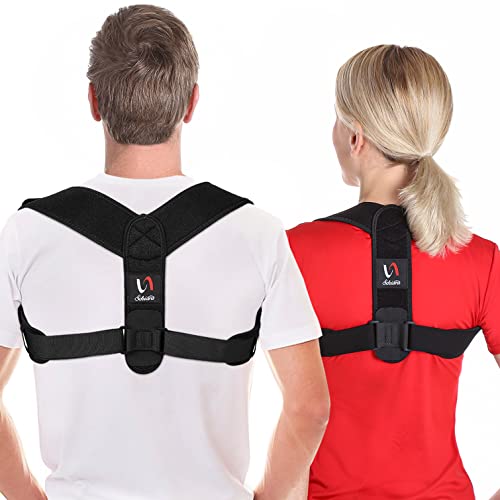
5. Schiara Posture Corrector for Men and Women — Best budget pick
The Schiara is the cheapest of the seven and still publishes a chest range, which is rare at this price.
Best for: trying the category without spending much Skip it if: your chest measures over 42 inches
As the cheapest pick here, the Schiara is the low-risk way to find out whether a brace helps you at all before committing more. What sets it apart from the other budget options is that it actually documents its fit: a stated 30" to 42" chest range, so you can measure and check first.
It weighs 4.94 oz, close to the featherlight ComfyBrace, and measures 0.21 x 9.84 x 2.76 in, a thin, flat strap. The maker says it stays invisible under clothes and aligns the back, neck, and shoulders during activity. For a first brace, light and thin is the right combination.
The ceiling is the limit. That 42" chest cap is an inch tighter than the ComfyBrace's 43", so larger wearers should look elsewhere. It is also upper-back only, with no waist support, and its slowness relative to the winner shows in a higher category position. Treat it as the affordable trial: if the strap earns its keep, you can step up to the structured Fit Geno or the waist-covering BraceTop later.
Pros:
- Cheapest of the seven
- Publishes a 30" to 42" chest range
- Light at 4.94 oz and thin at 0.21 in
- Maker claims it hides under clothing
Cons:
- Chest cap of 42" excludes larger wearers
- No waist or lumbar support
- No published warranty
6. Posturace Posture Corrector for Women & Men — Most versatile
The Posturace uses a one-size backpack-style layout that stretches across more body shapes than the fixed-size braces.

Best for: one-size flexibility across the day Skip it if: you want a documented chest range
Posturace goes one-size with a backpack-style design and fully adjustable straps, so there is no medium-or-large gamble at checkout. The maker describes ergonomic back buckle pads to keep it easy to slip on and off, which is worth something to hands that struggle with fiddly clasps.
It sits near the bottom of the price ladder, one of the cheaper options here, and the listing says it uses physical traction to open the shoulders and pull the upper back straighter. Posturace suggests starting at 20 to 30 minutes a day to avoid muscle dependence, a break-in note I like to see.
The weakness is the same shape as the sundpik's: sparse published detail. There is one size and a colour, but no weight and no chest measurement. "One size" is convenient right up until it doesn't fit, and there is no number to check against your own frame. It also stays high in its category ranking, the slowest mover of the seven, which tells you fewer buyers are reaching for it. Good if you want flexibility without picking a size; skip it if you want to verify fit first.
Pros:
- One-size fit removes the size guess
- Adjustable backpack-style straps
- Among the cheaper picks here
- Maker gives a gradual wearing schedule
Cons:
- No published weight or chest range
- Slowest seller of the seven
- No stated warranty
7. Fit Geno Invisilite Posture Corrector for Women — Best premium
The Invisilite is the thinnest brace here at a claimed 0.04 in, built to disappear under fitted tops.

Best for: a woman who needs it hidden under fitted tops Skip it if: your under-bust measures outside 32 to 38 inches
This is the most expensive pick, and the one built around staying invisible. Fit Geno claims a 0.04 in thickness that lays flat under a fitted shirt, in a beige colour meant to hide under lighter and thinner tops than a black strap would. If you dress up and don't want a visible bulge, this is the only pick designed around that.
It uses breathable nylon-spandex with hook-and-loop straps, sized by under-bust rather than chest, at 32 to 38 inches. The listing also states a lifetime satisfaction guarantee, the only warranty language in this whole set, plus hand-wash-only care.
Two catches. The under-bust sizing points this at women, so it is not a general pick, and 32 to 38 inches is a narrower window than the ComfyBrace's chest range. Being the thinnest also means it is the least structured, so it offers gentler correction than the fiberglass-stayed Fit Geno above. Pay the premium here for discretion, not for firm support. If you want firm hold or the widest fit, look back up the list.
Pros:
- Thinnest here at a claimed 0.04 in
- Beige colour hides under light tops
- Only pick with a stated guarantee
- Breathable nylon-spandex fabric claim
Cons:
- Most expensive of the seven
- Under-bust sizing aimed at women only
- Thinnest build means gentlest support
What actually decides this for an older buyer
Most guides to the best posture corrector for seniors line these up by how discreet they look. That is the wrong lens. Discretion decides which shirt hides it, not whether it helps you.
Two things actually decide it:
- Can you get it on alone? A lighter, plainer strap with fewer pieces wins here. The 4.66 oz ComfyBrace and the 4.94 oz Schiara are the easiest to manage. The 0.88 lb Fit Geno with four stays and a waist strap asks more of your hands.
- Where does your pain sit? Upper-back rounding wants a shoulder strap. Lower-back or waist ache wants the BraceTop's belt. Buying the wrong coverage means the brace does nothing for the pain you have.
Everything else, colour, brand, whether it hides under a blouse, is secondary. Fix the fastening question and the coverage question first, and the right pick usually narrows itself to one or two.
Can a senior put one of these on alone?
Can a senior put one on without help? Usually, but the design matters. Braces split into two camps, and one is far friendlier to stiff shoulders and weak grip.
The easy camp is the flat shoulder strap: the ComfyBrace at 4.66 oz and the Schiara at 4.94 oz. Fewer pieces, less weight, less to reach behind you for. The Posturace claims ergonomic buckle pads meant to help here too, though it publishes no weight to confirm how light it is.
The harder camp adds structure or a waist belt. The Fit Geno's four fiberglass stays and 0.88 lb body make it stiffer to wrangle, and the BraceTop's combined shoulder-and-waist layout has more straps to line up. Neither is impossible, but if reach or grip is limited, start with the lightest strap. You can always step up once you know a brace helps.
How firm should the support be?
Firmer is not automatically better. Every maker here says the same thing in different words: these are training aids meant to remind your muscles, not casts meant to hold you rigid. Fit Geno, Posturace, and the Invisilite all warn against wearing them so long that your back grows dependent.
That shapes the firmness you want:
- Gentle: the thin Invisilite at a claimed 0.04 in and the flat ComfyBrace. Least intrusive, easiest to build a habit with.
- Medium: the Schiara and sundpik straps, plain but present.
- Firmer: the Fit Geno with four fiberglass stays, and the BraceTop with its high-elastic support strip.
Start gentle and short. Both ComfyBrace and Posturace suggest short daily sessions at first, building up over time. That approach suits an older back better than clamping into the stiffest brace on day one.
When a different brace wins
The ComfyBrace is the default, but three clear situations flip the pick.
- If your pain is in the lower back or waist, choose the BraceTop. It is the only one here that wraps the waist as well as the shoulders. The lightweight ComfyBrace simply doesn't reach that far down.
- If you want to spend as little as possible, choose the Schiara. It is the cheapest of the seven and still publishes a 30" to 42" chest range, so you can check fit before buying.
- If you need it hidden under a fitted top, choose the Invisilite. At a claimed 0.04 in and in beige, it is the only pick built around disappearing under thin clothing, and the only one with a stated guarantee.
For a shared household brace, the Fit Geno's dual straps and one-size range of the Posturace both stretch across more bodies than a fixed size does.
The verdict
If you want the single easiest brace to live with, the ComfyBrace Posture Corrector is the best posture corrector for seniors. At 4.66 oz it is the lightest here, its 0.39 in flat profile stores anywhere, and its published 30" to 43" chest range is the widest documented in the set, so you can measure and check before you buy. It targets the rounded upper back most people mean when they talk about posture, and the maker's gentle break-in schedule suits an older back.
If your ache sits lower, the pick flips. The BraceTop Upgraded brace is the only one that pairs shoulder straps with a widened waist belt, so it covers the lumbar region the ComfyBrace leaves bare. Its exact advantage is that extra coverage, and the listing even names elderly wearers directly.
The cutoff is where your pain lives. Upper back and shoulders, take the light ComfyBrace. Lower back and waist too, step up to the BraceTop and accept the extra bulk. Both beat the thinner-documented picks because you can verify what you're buying.
FAQ
Is a posture corrector worth it for a senior?
A posture corrector is worth it for a senior mainly as a training reminder, not a cure. Every maker here describes these as habit aids worn in short daily sessions, not rigid supports. If your goal is a gentle cue to open the shoulders while you build the habit, a light strap like the 4.66 oz ComfyBrace is a reasonable, low-commitment start.
Which is the best value posture corrector here?
The best value posture corrector here is the Schiara. It sits at the cheapest end of the seven and, unlike the other budget options, publishes a 30" to 42" chest range so you can confirm fit before ordering. At 4.94 oz it is nearly as light as the winner, making it a low-cost, low-risk way to test whether a brace helps you at all.
How do I choose the right size posture corrector?
To choose the right size, measure your chest and match it to the listing's stated range. The ComfyBrace claims 30" to 43", the Schiara 30" to 42", and the Invisilite uses under-bust sizing at 32" to 38". Some picks here, including the sundpik and Posturace, publish no measurement, so you'd be buying without a number to check against.
ComfyBrace or BraceTop, which should I pick?
ComfyBrace or BraceTop comes down to where your pain sits. The ComfyBrace is lighter at 4.66 oz and covers only the upper back and shoulders, ideal for a rounded posture. The BraceTop adds a widened waist belt, the only lumbar coverage in this set, so choose it if you also have lower-back or waist pain and don't mind the extra bulk.
What is the biggest mistake buying a posture corrector?
The biggest mistake buying a posture corrector is wearing it too long too soon. Several makers here, including Fit Geno and Posturace, warn that overuse can make your back rely on the brace. Start with short daily sessions, 5 to 30 minutes depending on the maker's note, and build up gradually so your own muscles keep doing the work.
Start by measuring your chest, then match it to a brace that publishes a range you fit inside. That one step rules out half the guesswork. For most older buyers the ComfyBrace is the sensible default: it is the lightest strap here, easy to fasten alone, and it documents its fit so there are no surprises at the door. If your trouble runs lower down your spine, the BraceTop's waist belt is the better answer. Either way, ease in slowly and let your own muscles carry the load over time.