Best Posture Corrector When Training Hard All Week

Five back braces compared on resistance, weight and coverage, with a clear pick for lifters, a beginner option, and the rigid jacket that outclasses all of them on support.

By Tanner TorresUpdated 16 min read
On this page
- Best posture corrector for muscle recovery at a glance
- Who each of these five picks is actually for
- Does a posture corrector help muscle recovery?
- Resistance band or compression brace: which do you need?
- 1. PRIMEKINETIX PostureMedic Plus Strength Dynamic Posture — Best overall
- 2. Whyte Lyon Upper Back Posture and Neck Hump Corrector — Best for heavy use
- 3. The Natural Posture Posture Corrector for Men and Women — Best for beginners
- 4. DCF Back Posture Corrector — Best budget pick
- 5. BraceAbility TLSO Full-Body Back Brace Support — Best premium
- The verdict
- How long should you wear one each day?
- What the listings do not tell you
- FAQ
The best posture corrector for muscle recovery is the PRIMEKINETIX PostureMedic Plus Strength, an 8 oz resistance-tubing trainer built around a stretch, strengthen and stabilize program rather than passive strapping. If you want something you can wear for hours instead of drill with, the Whyte Lyon Upper Back Corrector weighs 4.51 oz and works as a low-profile daily brace instead.
Pick wrong here and the failure mode is specific. You strap on a rigid brace, your shoulders sit back for eight hours, and the muscles that were supposed to hold that position never fire once. Two weeks later the tightness is back and your mid-back is weaker than when you started. That is the trap in this category. A brace that does the work for you is not the same as a tool that makes your body do the work, and only one of the five picks here is genuinely the second kind.
Best posture corrector for muscle recovery at a glance
| Pick | Support type | Weight | Price |
|---|---|---|---|
Best overall PRIMEKINETIX PostureMedic Plus Strength |
Resistance tubing, active drills | 8 oz | Check Price |
Best for heavy use Whyte Lyon Upper Back and Neck Hump Corrector |
Neoprene shoulder pull | 4.51 oz | Check Price |
Best for beginners The Natural Posture Posture Corrector |
Mesh brace, two support bars | Not listed | Check Price |
Best budget pick DCF Back Posture Corrector |
Elastic strap harness | 4.97 oz | Check Price |
Best premium BraceAbility TLSO Full-Body Back Brace |
Rigid shell jacket, dual pulley | 2.4 lb | Check Price |


Who each of these five picks is actually for
I lined these up by buyer, not by feature count. The five listings solve five different problems, and the specifications make that split obvious once you read them side by side.
- The lifter. You train four or five days a week and your front side is tighter than your back. You want something that makes the rear delts and mid-back work. That is the PRIMEKINETIX, and it is the only pick here built on resistance tubing.
- The all-day wearer. You want a shoulder cue you forget about by mid-morning. Weight decides this one, and at 4.51 oz the Whyte Lyon is the lightest thing here.
- The desk worker with lower back ache. Shoulder pull alone will not help you. The Natural Posture brace is the only mid-tier pick that names lumbar support and includes two support bars.
- The unconvinced. You have never worn one and do not want to spend much finding out. The DCF is the cheapest of the five and fits chests from 28 to 43 inches.
- The medical case. Post-surgery, a fractured spine, thoracic kyphosis. That is a rigid brace, and the BraceAbility TLSO is the only one here with a hard shell and a 3.75 x 24.8 x 15.5 in footprint.
Notice what that list does not include: someone who wants one product to do all five jobs. No pick here manages it. Choose the profile you actually fit.
Does a posture corrector help muscle recovery?
Here is the honest answer, and it is the reason the search term "muscle recovery" needs handling carefully. None of these five listings publishes a recovery study, a measured outcome, or a clinical figure. What they publish is design intent.
The PRIMEKINETIX comes closest. Its listing states the Plus model helps alleviate chronic neck and shoulder tension after intense training and guides the body into anatomical alignment to open the chest. That is a manufacturer claim about mechanism, not evidence of faster recovery, and I am not going to dress it up as more than that.
What you can reason about is the mechanical logic. Tension after heavy pressing, rowing or desk work tends to sit in the same places: pecs pulling the shoulders forward, upper traps loaded, mid-back underused. A resistance-based trainer asks those underused muscles to contract. A compression brace instead holds the position for you.
So the question is not which product speeds recovery. It is which mechanism suits how you got tight in the first place. If your problem is training volume, active loading fits. If your problem is eight hours in a chair, a positional cue fits. Treat any "recovery" wording on a listing as a description of intent and judge the tool on its structure instead.
Resistance band or compression brace: which do you need?
This is the real dividing line in the best posture corrector for muscle recovery category, and it gets almost no attention in the shopping process.
A resistance trainer works like exercise equipment. Tubing runs across your back, you move against it, and the muscles do the correcting. The PRIMEKINETIX is the only pick here in that class, and its listing frames the whole thing as a three-phase program: stretch, strengthen, stabilize.
A compression brace works like a splint. Straps hold your shoulders in position while you wear it. The Whyte Lyon, The Natural Posture and the DCF all sit here. So does the BraceAbility, at a far more serious level of rigidity.
Three practical differences:
- Wear time. Resistance work is sets and minutes. Compression can be hours, which is why weight matters more for braces than for trainers.
- Muscle load. Only the resistance model puts your mid-back under active tension. A brace does not.
- What happens when you take it off. With a trainer, the adaptation is in the muscle. With a brace, the cue leaves with the strap.
Neither type is wrong. Braces earn their place for structural problems, medical cases and people who need immediate relief from a slumped position. But if you train hard and want your posture to hold on its own, resistance is the mechanism you want, and only one product here provides it.
1. PRIMEKINETIX PostureMedic Plus Strength Dynamic Posture — Best overall
The only pick here that loads your mid-back instead of holding it, which makes it the right tool if training volume is what left you tight.
Best for: lifters and dense-muscled athletes who want an active drill tool Skip it if: you want passive all-day support under a work shirt
At 8 oz this is the heaviest of the four soft picks, and the weight tells you something. That is high-tensile tubing, not mesh and velcro. PRIMEKINETIX says the Plus Strength level is engineered for athletes and people with high muscle density who need more stimulus than the Original strength offers. Read that as a warning about resistance level rather than a fit note: if you are not already training, this is more tension than you want.
The programming is what separates it. The listing describes a stretch, strengthen and stabilize methodology with an instructional manual of advanced drills, which is a very different proposition from a brace with an adjustment chart. You are meant to work with it, not wear it.
The brand also claims professional-grade tubing built for rigorous daily use and says sports chiropractors and athletic trainers use it. That is marketing language and I will treat it as such, but the 8 oz figure and the X-Large orange build are consistent with a heavier-duty article than the rest of this set.
The trade-off is real. This is the second most expensive pick and it will not sit invisibly under a shirt for eight hours. It also sells more slowly here than the three cheaper braces, which reflects who it is built for.
Pros:
- Only resistance-tubing trainer in this five-product set
- Three-phase stretch, strengthen and stabilize program included
- 8 oz build, heaviest of the soft picks
- Resistance level aimed at trained, dense-muscled users
- Manufacturer cites high-tensile professional-grade tubing
Cons:
- Not designed for long passive wear under clothing
- Resistance level too high for untrained beginners
- Second-highest price position in this lineup
- Only one seller lists it, so no fit-size comparison shopping
- Single X-Large size and orange colour published
2. Whyte Lyon Upper Back Posture and Neck Hump Corrector — Best for heavy use
The lightest brace here at 4.51 oz, and the one buyers choose most often in this set, which makes it the sensible default for long daily wear.

Best for: daily wearers focused on rounded shoulders and neck hump Skip it if: your chest measurement sits outside the one-size range
Two numbers make the case. It weighs 4.51 oz, the lowest published weight of the five, and it sells faster than anything else in this lineup. For a product you might wear for hours, low mass is not a luxury feature.
Whyte Lyon describes it as using downward force to pull the shoulders back, made from soft neoprene against the skin, and targets rounded shoulders plus what the listing calls buffalo hunchback alignment. That is a narrower brief than the full-back picks here, and the narrowness is the point. It addresses the upper back and nothing else.
The white colourway is worth a thought. Under a white or light shirt it hides well. Under dark fabric it can read through, which is the opposite of every black brace in this set.
Where it loses is coverage and adjustability. One size fits most means you are trusting a size chart rather than picking a size, and there is no lumbar element at all. Against The Natural Posture brace it gives up lower back support and two support bars; against the PRIMEKINETIX it gives up any active loading of the muscles you are trying to wake up. It holds a position. It does not train one.
Pros:
- Lightest published weight in this set at 4.51 oz
- Sells faster than every other pick here
- Soft neoprene construction stated by the brand
- Targets rounded shoulders and neck hump specifically
- Cheapest of the four soft braces after the DCF
Cons:
- One size fits most, so no size selection if you fall outside it
- No lower back or lumbar support component
- White colour shows through dark clothing
- No published warranty or model number
3. The Natural Posture Posture Corrector for Men and Women — Best for beginners
The only mid-priced pick that addresses the lower back as well as the shoulders, with two support bars and a fully adjustable waist strap.

Best for: desk workers who want lower back support as well as shoulder pull Skip it if: you need something slim under fitted clothing
This is the most complete soft brace in the set. The listing describes breathable mesh fabric, wide soft velvet straps, velcro fasteners and two support bars, all latex-free. Two support bars is the detail that matters, because it is the only pick outside the rigid BraceAbility jacket that publishes any structural element.
Adjustment is the other strength. The Natural Posture says both the elastic waist and the shoulder straps tighten or loosen to your chosen level of compression, which is what a beginner actually needs. You start loose, wear it briefly, and increase tension as your tolerance builds. A fixed-tension brace gives you no such ramp.
The Large size and black colour are what is published, and black is the practical choice under most work clothing. The listing is also refreshingly honest in one bullet, noting that adopting an upright posture takes time.
The gaps are worth naming. No weight is published, which is the one figure I would want most for a brace you plan to wear all day. It also carries more hardware than the Whyte Lyon: mesh panel, waist band, two bars. That is more support and more bulk, so under a fitted shirt it is the less discreet of the two. And like every soft brace here, it holds your shoulders rather than making them work.
Pros:
- Two support bars, rare outside the rigid jacket here
- Adjustable compression at both waist and shoulders
- Breathable mesh with wide velvet straps, latex-free
- Addresses lower back as well as shoulder alignment
- Black finish stays hidden under most work clothing
Cons:
- No published weight figure anywhere on the listing
- Bulkier than the Whyte Lyon under fitted clothes
- Passive support only, no active muscle loading
- Sells more slowly than the Whyte Lyon pick
4. DCF Back Posture Corrector — Best budget pick
The cheapest of the five and the one with a published chest range, which makes it the low-risk way to find out whether you tolerate a brace at all.

Best for: first-time buyers testing whether a brace suits them at all Skip it if: your chest falls outside 28 to 43 inches
At 4.97 oz this is barely heavier than the Whyte Lyon, and it is the least expensive pick here by price position. What you get is a straightforward elastic strap harness with adjustable buckles, which DCF says accommodates chest sizes from 28 to 43 inches.
That range is the most useful number on the listing. It is the only pick in this set that publishes actual body measurements rather than a garment size or a "one size fits most" claim, so you can check your fit with a tape measure before ordering instead of after. For a first purchase, that removes the main reason braces get returned.
DCF describes breathable, durable materials and targeted support for discomfort tied to poor posture. Standard category language, and I would treat the pain-relief wording as intent rather than a measured outcome.
The trade-offs come with the price. No size, colour or model number is published, so you are ordering with less information than any other pick here. There are no support bars, no lumbar panel and no resistance element, which makes it the simplest mechanism in the group. It also sells far more slowly than the two braces above it. Use it as a trial, and step up if you find you wear it daily.
Pros:
- Cheapest pick in this five-product set
- Publishes a usable chest range, 28 to 43 inches
- Light at 4.97 oz for all-day wear
- Fully adjustable elastic straps for tension control
Cons:
- No size, colour or model number published
- No support bars or lumbar panel
- Slowest seller of the five picks here
- Simplest strap design, so least support of any pick
5. BraceAbility TLSO Full-Body Back Brace Support — Best premium
A rigid shell jacket in a different category of support entirely, and the only pick here built for post-surgery and structural spinal cases.
Best for: post-surgery or structural cases needing rigid full-torso support Skip it if: you only want a shoulder cue during workouts
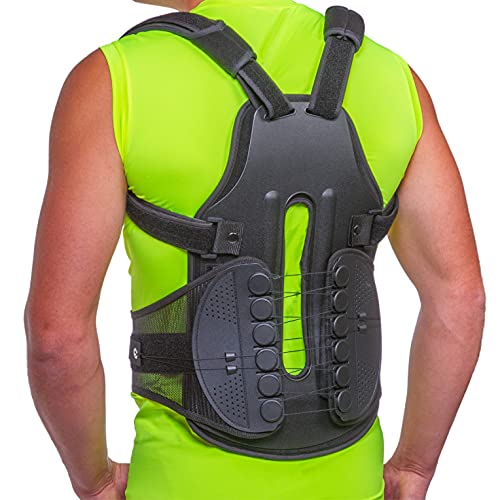
The weight tells the whole story. At 2.4 lb this is roughly five times the mass of the Whyte Lyon, and its 3.75 x 24.8 x 15.5 in dimensions describe a jacket rather than a strap. Model BRL-XL, black, X-Large.
BraceAbility positions it for thoracic kyphosis, scoliosis, fractured spine, Parkinson's disease and post-surgery recovery, and says the jacket covers the entire back to address both upper and lower pain. The dual-pulley system is the standout mechanism here: the listing says it lets you adjust how much pressure and compression the brace applies, which gives you far finer control than a velcro strap. Shoulder straps go on like a backpack.
To be clear about scope, this is a medical-grade support and the conditions in that list belong with a clinician. I am not going to read the listing's condition names as a treatment claim, and if you are in any of those categories the brace choice is a conversation with your surgeon or physiotherapist rather than a shopping decision.
For everyone else, it is the wrong tool. It is the most expensive pick here, the bulkiest by a wide margin, and it is the opposite of what a training-focused buyer wants. A rigid shell does all the stabilising work your muscles were supposed to do. Correct for a healing spine. Counterproductive if you are chasing strength.
Pros:
- Rigid full-torso shell, unique in this set
- Dual-pulley system for fine compression control
- Covers upper and lower back together
- Published dimensions and model number, BRL-XL
- Backpack-style application, adjustable shoulder straps
Cons:
- Heaviest pick at 2.4 lb, impossible to wear discreetly
- Highest price position in this lineup
- Removes muscle load rather than adding it
- Overbuilt for general posture or training use
The verdict
If you train regularly and your shoulders round forward from volume rather than injury, buy the PRIMEKINETIX PostureMedic Plus Strength. It is the only pick in this set that loads your mid-back instead of holding it, and its 8 oz tubing build plus a stretch, strengthen and stabilize program make it a piece of training equipment, not a splint.
If you sit for a living and want a cue you can wear from nine to five, buy the Whyte Lyon corrector. At 4.51 oz it is the lightest here and it sells faster than anything else in this group, which suits a product judged mainly on whether you keep it on.
The cutoff is wear time. Under 30 minutes at a stretch, you want resistance and you want the PRIMEKINETIX. Over two hours at a stretch, you want low weight and a soft brace, and the Whyte Lyon wins on 4.51 oz alone.
Two adjustments to that split. If your lower back aches as much as your shoulders, The Natural Posture brace adds two support bars and a lumbar strap the Whyte Lyon has no answer to. And if a clinician has told you that you need rigid stabilisation, none of the soft picks apply and the 2.4 lb BraceAbility TLSO jacket is the only relevant product here.
How long should you wear one each day?
Nobody puts a schedule on the box, so here is a sensible way to build one.
- Start at 15 to 20 minutes. Any brace or trainer asks your body to hold an unfamiliar position. The soreness that follows a first long session is why people abandon these after three days.
- Add time gradually across two weeks. The Natural Posture and DCF both let you adjust strap tension, so increase minutes before you increase compression.
- Cap passive wear. If a brace is holding your shoulders for most of the day, your mid-back is doing nothing. Use it in blocks, not continuously.
- Treat resistance work as exercise. The PRIMEKINETIX belongs in a warm-up or accessory slot, in sets. Its manual sets out the drills.
- Rigid jackets follow instructions, not habit. The BraceAbility TLSO is prescribed wear. Follow whatever your clinician specifies.
The general rule for the best posture corrector for muscle recovery is that shorter and more frequent beats longer and constant. Two 20-minute blocks with an active cue will do more for your mid-back than eight hours strapped into position.
What the listings do not tell you
Four blanks worth knowing about before you order.
Warranty. Not one of the five listings publishes a warranty term. The PRIMEKINETIX bullet trails off mid-sentence with "backed by a", which is not a coverage figure I can quote. Assume standard Amazon returns and nothing more.
Weight, in one case. The Natural Posture brace publishes no weight. Every other pick does, and for a product you wear against your skin that omission is genuinely inconvenient.
Sizing, unevenly. The BraceAbility publishes full dimensions and an X-Large size. The DCF publishes a chest range but no size at all. The Whyte Lyon publishes one size fits most. Three different sizing systems across five products, so measure yourself before you choose.
Seller depth. All five have a single seller. There is no second listing to cross-check a size chart against or to source a replacement strap from.
Materials, partially. Neoprene, mesh, velvet and latex-free are stated for some picks. Nothing publishes a full material breakdown, and none states the tubing gauge on the resistance model.
FAQ
Is a posture corrector worth it for muscle recovery?
A posture corrector is worth it for recovery only if you choose the active kind. Passive braces hold your shoulders back, which relieves tension immediately but leaves the mid-back untrained. A resistance model like the 8 oz PRIMEKINETIX asks those muscles to contract instead. None of these listings publishes recovery data, so judge the mechanism, not the marketing.
Which is the best value posture corrector here?
The best value pick is the Whyte Lyon corrector rather than the cheapest one. It sits in the entry price tier, weighs just 4.51 oz, and sells faster than every other product in this set. The DCF costs less but offers a simpler strap harness with no support bars. Paying a little more buys neoprene construction and a proven daily-wear design.
PRIMEKINETIX or Whyte Lyon: which should I buy?
Between PRIMEKINETIX and Whyte Lyon, the deciding factor is wear time. The PRIMEKINETIX is resistance tubing used in short sets, built for athletes who want their mid-back working. The Whyte Lyon is a 4.51 oz neoprene brace for hours of passive wear. Buy the first if you train hard, the second if you sit at a desk all day.
Will these braces fit my chest measurement?
Chest measurement matters most on the DCF, the only pick publishing a range: 28 to 43 inches. The Whyte Lyon is one size fits most, so check its size chart carefully. The PRIMEKINETIX lists X-Large, as does the 2.4 lb BraceAbility TLSO, which also gives 3.75 x 24.8 x 15.5 in dimensions. The Natural Posture lists Large.
What mistake do first-time posture corrector buyers make?
The mistake first-time buyers make is over-wearing a rigid brace on day one. Eight hours of maximum compression leaves you sore and your muscles idle. Start at 15 to 20 minutes and build up. Picks with adjustable straps, like The Natural Posture and the DCF, let you raise tension slowly rather than committing to full compression immediately.
Measure the widest point of your torso with a tape measure, then match it to whichever sizing system your chosen pick publishes. That single step prevents most bad outcomes in this category. From there, the PRIMEKINETIX PostureMedic Plus Strength earns the default recommendation for one reason the other four cannot match: it is the only pick that leaves your mid-back stronger than it found it. Every brace here can hold your shoulders in place for an afternoon. Only one asks the muscles to learn the job themselves, and that is the difference between relief and progress.